“Paulina is the favorite role I've ever done. It was always my favorite. I think it is the best-written female role in Shakespeare. She’s fantastic. In this play, all of the women are smarter, stronger, more resilient, more resourceful than the men… And they all have beautiful monologues.”
— Donna Ison
The Winter's Tale: Shakespeare In The Moment

Donna Ison in conversation with the writer at 3rd Street Stuff in Lexington (Photo: Drew Barr)
By Drew Barr
Contributing Writer
Donna Ison gives one the impression she can tackle any problem.
When we met for coffee at a bustling Third Street Stuff, the actor quickly sussed out the optimal place for us to sit, helped me plug in my devices, and even worried that my chair was too close to the edge of our raised table by the window.
“If you go over,” she said with a smile, “I’m ready to grab you.”
She is an Enneagram 5, aka “The Investigator, The Iconoclast, The Problem Solver,” so it’s no wonder Ison finds herself drawn to complex characters like Paulina in “The Winter’s Tale.” She will be playing the role for the second time in her career at The Farish Theater in Lexington’s Central Library this weekend, Feb. 7 - 9. The Frankfort-based Bluegrass Theatre Guild is producing Shakespeare’s play under the direction of Jonathan Hall.
“Paulina is the favorite role I've ever done. It was always my favorite. I think it is the best-written female role in Shakespeare. She’s fantastic. In this play, all of the women are smarter, stronger, more resilient, more resourceful than the men… And they all have beautiful monologues.”
Paulina is one of Shakespeare’s great truth-tellers. “A bold woman with a sharp tongue,” according to science fiction master and ultimate “Bardolator,” Isaac Asimov. In the famous first scene of The Winter’s Tale, King Leontes of Sicilia enlists his pregnant wife, Hermione, to persuade his visiting friend, Polixenes, to extend his stay. When she succeeds, Leontes abruptly accuses Hermione and his friend of having an affair. Leontes’ retributive anger leads to Hermione’s tragic imprisonment, the death of their only son, Mamillius, and the secret exile of their newborn daughter, Perdita. Through it all, only Paulina dares to confront Leontes when all others kowtow to his irrational decisions. In the end, Paulina, and the actress playing her, guards the secret of the play’s healing resolution.
“I see Paulina as one of Shakespeare's witches. She's called ‘witch.’ She's called ‘crone.’ Magic is spoken of. There are a lot of those references. I think it explains so much… I love the pure magic of it.”
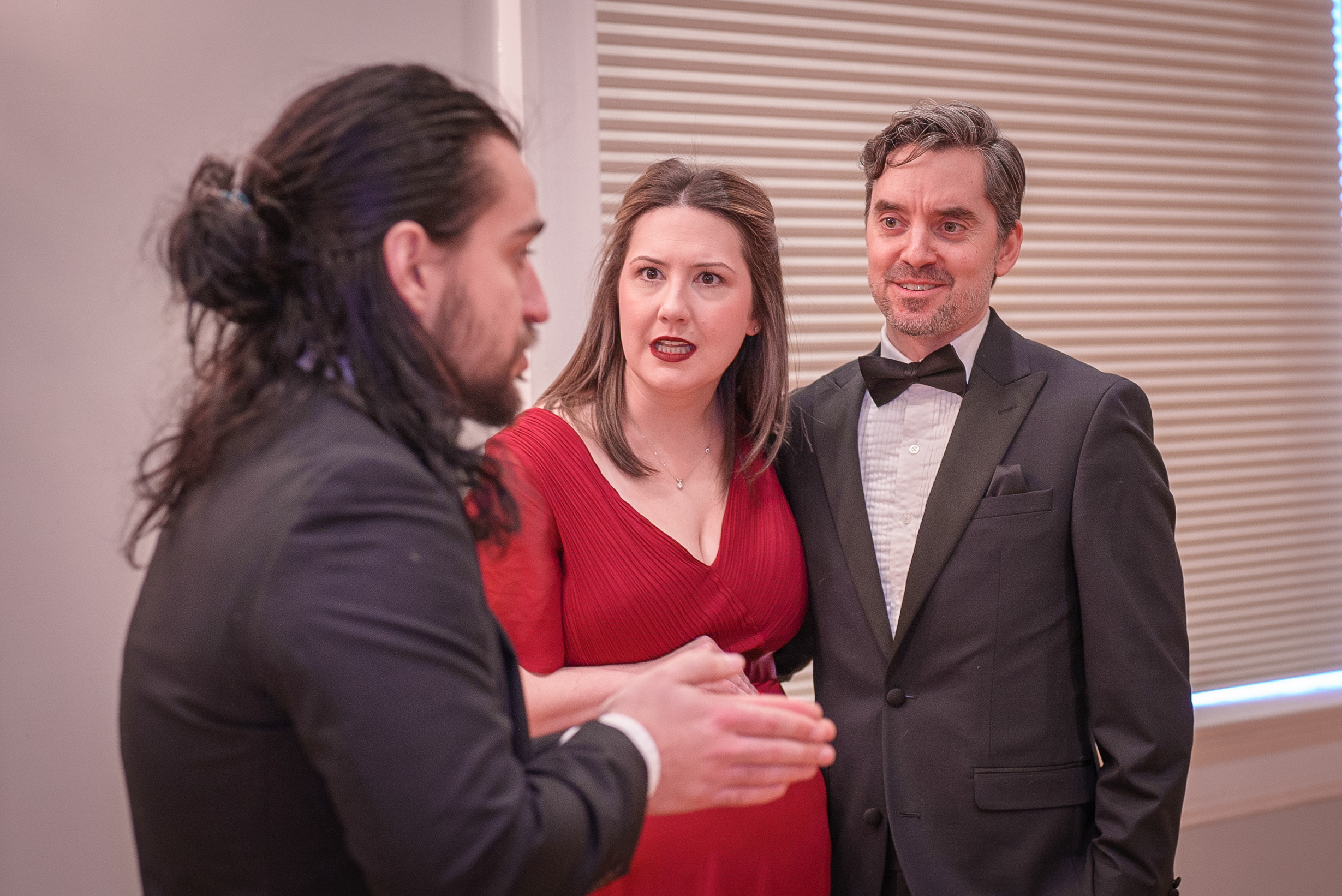
John Bishop as Polixenes (L), Catherine Osborne as Hermione (Center), Jonathan Hall as King Leontes
Though she considers herself very much a writer these days, Ison’s roots in the theater go back at least as far as college, if not before:
“I'm originally from Mount Sterling, lived here in Lexington and then went to college. I was a college hopper. I did Murray, Morehead — they have an amazing theater program. That is actually where I graduated from. Then, I came back here for grad school at UK before moving to New York to do the theater thing. I think I always knew that I would go to New York. I grew up in a small town and hearing about it was like…the song, the whole I’ve got to go to New York. You can make it anywhere… And my then-husband was an actor and director at the time…. So we moved to Washington Heights. I was in Washington Heights before the musical “In The Heights” even existed. And I was doing quite a bit of theater. I was even an elf at Macy's, like the whole David Sedaris thing. My name was Eggnog. You get to name yourself.”
Over time, despite the magic of the city and the inspiration of the song, New York actor life began to lose its luster.
Ison recounts, “I was doing the show, ‘Belles,’ which I had done in Lexington. But I did not enjoy acting anymore, really. There was some stage fright to it, but the other thing was that I just felt vapid. I was just not passionate about it anymore. I was getting ready to go on stage and literally thought, ‘If I run and get on the subway, they can't catch me. I don't have to do this.’ And I thought, ‘If you dread this this much, if you really are this tired of acting, you should not be doing it.’ And that's when I started writing”
Tackling difficult language — like that found in Shakespeare — is something the Montgomery County native has been doing since childhood. Some of her earliest memories involve writing poetry:
“I remember the first poem I wrote when I was like five years old. I wrote a lot as a child. I wrote lots of little short stories, lots of little poetry. I loved words. Just anything to do with them, but if you're doing theater, you don't have a lot of time. I was taking three, four hours of classes and teaching and doing shows. And, during one of those New York winters, I was on my way to see a new manager, so I was dressed. I was cute. And I fell in a snow ditch. I got out and walked back to my apartment, called the manager and said, ‘I'm sorry I won't be there. I'm not doing this.’ And that was literally it. I was like, no. The Universe is telling me no. And so I wrote a show, and a theater picked it up. And I went to that show, and I sat in the back, and I watched them say my lines and I was like, ‘Oh, this is much better. I much prefer this.’ I realized that I truly loved writing more. And, yes, I've written a couple of novels that are out there in the world floating around. And I'm on my third. I'm over halfway through it. I'm in a writer's group. I teach at the Carnegie. I do the writer-y thing.”
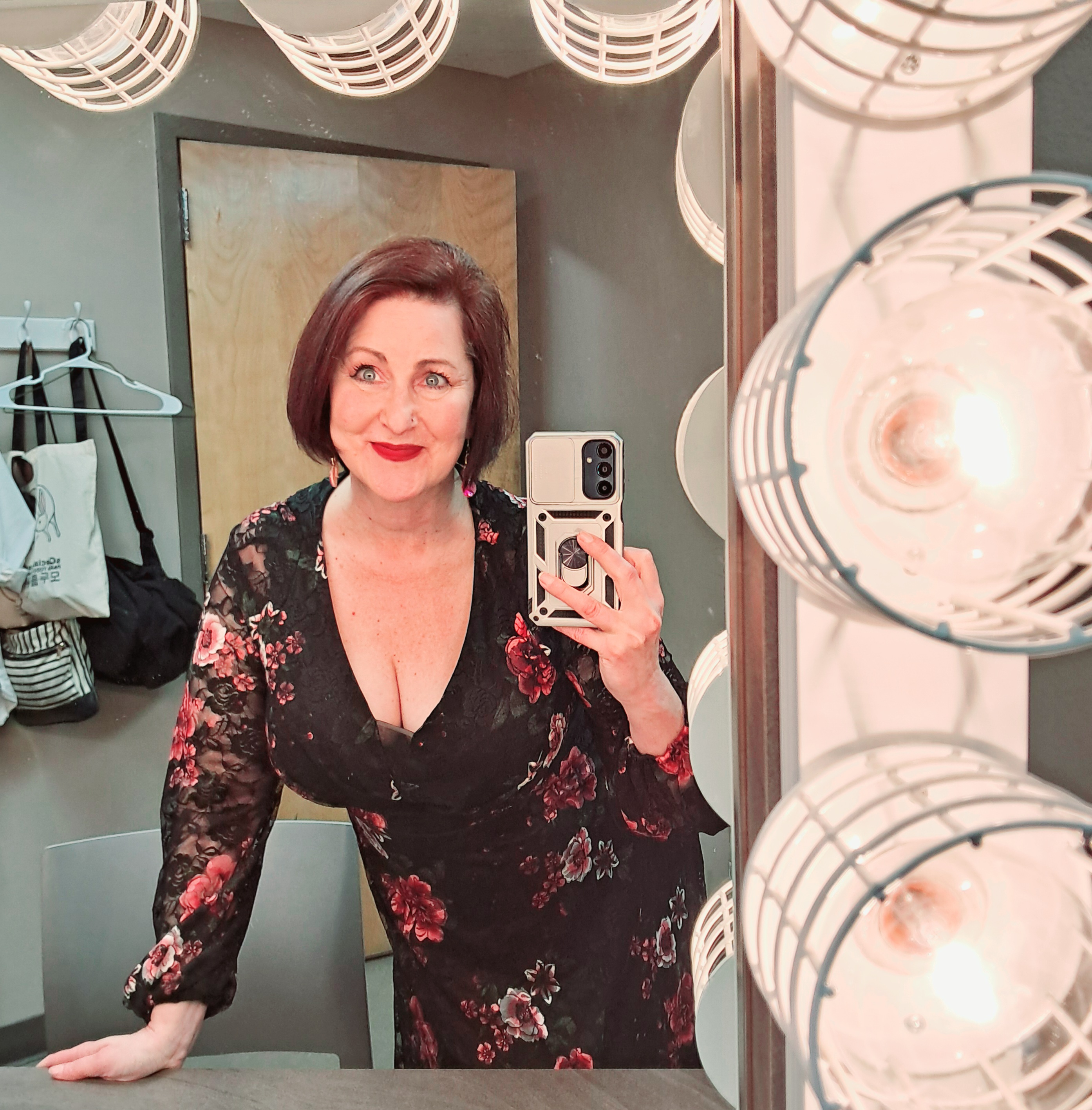
Ison in dressing room during rehearsal (Image: Selfie)
Ison believes writers can be divided into either “Plotters” or “Pants-ers” and, though she likes to carefully map out the events of a novel before she begins writing, the energy and success of her life clearly derive from an underlying seat-of-the-pants proclivity. Hers seems to be a path of improvisation and instinct, trusting her gut and little signs from the Universe about where to go next.
“After I came back to Lexington from New York, I pretty much considered myself a recovering actress. I was just like, ‘I'm not doing it anymore.’ And for many years did not,” Ison notes. “But, as a writer, I process the world — particularly the parts I find most disturbing or challenging — through words. I’ve found it’s even more powerful to speak these words aloud and fully own them. I’ve done a lot of performance poetry…and I’ve put together a lot of activist theatre on LGBTQ issues with the Carnegie Center, facilitating workshops where individuals can write their truth, and then we put the results into play form with the authors performing their own work.”
This actor/writer’s variety of experience is a testament to the lively theater community in Lexington. She has worked with many if not all the long-standing (and in some cases no longer standing) companies. Ison has witnessed the changes of the local theater scene and can attest to what she calls its current “burgeoning” state. Despite repeated decisions to leave the life of an actor behind her, the stage and the pull of the spotlight continue to intrigue her.
“Oh, I’ve said this is going to be my last show. I did it again,” she pronounces. “’I'm retiring. This is it. I'm done.’ One, lines are harder to learn. They just are. And I need to finish this book. I have personal projects that I really need to finish. And the theater is a kind of a diversion. You know, it takes time, where I could be doing other things. So, I always say, ‘I'm never doing it again,’ and then I always do.”
"The Winter’s Tale” marks the third production Donna Ison has acted in over the past three years, and she can trace its reappearance in her life to a fateful comment thrown out into the world:
“I have always loved Shakespeare and did a lot of Shakespeare back in the day. And then a couple of years ago, I made the mistake of being in a car with a friend and being like, ‘I love Shakespeare. But there's just no good Shakespeare for middle-aged women. There just are no roles unless you're doing Lady M.’ And, it wasn't a week later that somebody called and said, ‘Would you consider doing Merry Wives of Windsor?’ And I'm like, Damn! I forgot ‘Merry Wives of Windsor.’ I threw it out in the universe. Now what am I going to do? So, I did it the summer before last, the summer of '23.”
Then, in the summer of ’24, Ison performed in ActOut Theater Group’s production of Del Shore’s “A Very Sordid Wedding,” where once again the theater gods impacted her life:
“That's how I met Jonathan, and I really enjoyed working with him. And so when he was doing ‘The Winter’s Tale,’ he asked if I would audition and I was like, ‘Um….’ I really had not decided up until the day of the audition. And then I thought, ‘It would do [me] good. This is a good show. It's a good role.’”
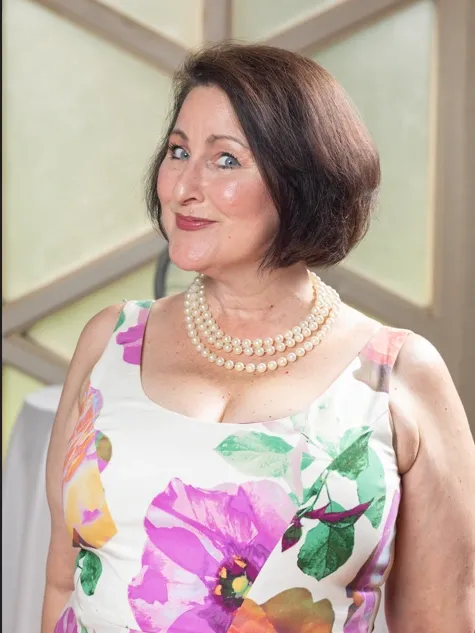
Donna Ison as Latrelle in the ActOut Theater Group production of “A Very Sordid Wedding.” (Photo: ActOut Theater Group)
As with other late-Shakespearean “romances,” “The Winter’s Tale,” traverses time and geographical distance in its untangling of the misfortunes brought about by human frailty. The play’s challenging mix of inscrutable psychology, pastoral comedy, death and miraculous resurrection has led many scholars to categorize it as one of Shakespeare’s “problem plays.” Ison, “The Investigator,” finds it a source of fascination, particularly under the guidance of Jonathan Hall’s vision:
“I've always loved ‘The Winter’s Tale’ because of the problem of it. They've got this great marriage and then, suddenly, Leontes is like, ‘She's having an affair.’ And there's no real reason. It's a very interesting experience for audiences because they’re wondering, ‘What is happening? Is this real? Is it in his mind? Is it magic?’” Ison adds, “And Jonathan’s setting it modern, so we'll be utilizing things like technology: Leontes is looking through pictures on his phone, and he’s trying to find proof and finds Hermione and Polixenes are across the room from each other and she's looking his way, or they're standing too close…. And the other thing is that this show is incredibly relevant right now. I mean, it's basically a tyrant who is surrounded by men who are afraid to tell him no. And he does horrible, irrational things because the people around him are basically silent accomplices and no one will stop him. Paulina is the only person that will step in and actually tell him that what he's done is wrong. I feel like it's very timely in that way. Those were kind of the reasons I came back to it. One, I love the role. Two, I think it's really relevant.”
When she first played Paulina, back when many of her current cast members had yet to be born, Donna says she knew her lines but didn’t really understand the play and its power dynamic.
“At that point, I hadn't really dealt with patriarchy. I really hadn't…dealt with sexual harassment — or I think more than that — a woman's words not carrying the same weight as a man’s,” she recalls.
Donna Ison returns to the role with a lifetime of experience and, according to the Enneagram, a spiritual and psychological predisposition equal to understanding the character, the play and Shakespeare’s underlying meaning. We the audience can rest assured that our experience of “The Winter’s Tale” at The Farish Theater in downtown’s Central Library will benefit from Donna’s wisdom and the whole team of Bluegrass Theater Guild. No fear of falling. They’ve got us.