

“It’s not about what I want for myself. What I want for myself is my own business. It’s about the fact that I live in America, and America is supposed to be about freedom, and America is supposed to be about choices.” — Harvey Fierstein
Relighting The Torch

(L-R) Baelyn Lindfors, Daniel Ellis, Joe Ferrell, Wesley Nelson, Sherry Jackson Thompson, Wylie Caudill, Tommy Flanigan
By Drew Barr
Contributing Writer
Photos: Rich Copley for ActOut Theatre Group
“There are easier things in life than being a drag queen. But I ain’t got no choice. Try as I may, I just can’t walk in flats.” So confides Arnold Beckoff, the main character of Harvey Fierstein’s “Torch Song,” which begins performances on Friday, Feb. 28, at The Farish Theatre, under the direction of Joe Ferrell.
Fierstein’s ground-breaking, award-winning play began life as a one-act, called “The International Stud.” It was the 1970s, New York’s Off-Off-Broadway scene was in full swing and, thanks to the 1969 Stonewall riots and the success of Mart Crowley’s “The Boys in the Band,” openly gay characters were beginning to poke their heads out of the theatrical closet.
When Kenny Hill of La MaMa Experimental Theatre Club suggested “The International Stud” to his boss, Ellen Stewart, the executive director and eponymous La MaMa herself, she dismissed it. “I know that bar, The International Stud, and I ain’t gonna do no play about no backroom bar. Mr. Fierstein wants to run around on stage in bloomers and I ain’t gonna have it.” And that was that. Or so they all thought. But, in a twist that could only be dreamt up by a dramatist, after Kenny Hill perished in a bathhouse fire, Harvey Fierstein replaced him as La MaMa’s assistant, and Ms. Stewart agreed to give “The International Stud” performance dates in the busy theater’s calendar as payment.
“Tell her it’s a trilogy,” the play’s director urged Fierstein, “so we don’t have to fight her for the next two years to get the space again.” He did. “And so,” Fierstein remembers, “Ellen was stuck.”
But so was he — Fierstein now had to write two more plays.
Five years later, those three plays — combined into an evening called “Torch Song Trilogy” —enjoyed sold-out crowds on Broadway and won several awards, including the 1983 Tony Awards for Best Play and Best Actor.
The journey from the gay ghetto of New York’s downtown arts scene to critical and commercial triumph became the stuff of theatrical legend and stands as a testament to Fierstein’s extraordinary achievement as a playwright. Out of the ultra-specific struggles of a fiercely outspoken drag queen, Arnold Beckoff, Harvey Fierstein wrote a story that spoke to a multitude of viewpoints amid the swirling changes of late 20th century American society, with men, women, parents and children all striving for a new understanding of what constitutes a family, and how to respect individual rights while maintaining a sense of communal well-being.
The play and its widespread appeal became a bit of a lightning rod, as some newly liberated homosexuals felt betrayed by what they perceived as Fierstein’s capitulation to traditional social mores. “When I wrote ‘Torch Song,’ I was vilified by the gay community: ‘He’s just trying to make us like heterosexuals. I don’t want to ever get married. Who the hell wants children?’ Now, look around,” Fierstein said. “It’s not about what I want for myself. What I want for myself is my own business. It’s about the fact that I live in America, and America is supposed to be about freedom, and America is supposed to be about choices.”
Almost 50 years after its first performance, the trilogy, which Fierstein has condensed and retitled, “Torch Song,” remains powerfully relevant in its championing of every person’s desire for love and acceptance. The cast members of ActOut Theatre Group’s production marvel at how the play speaks as directly to the world we live in today as it did to its original audiences.
(L-R) Sherry Jackson Thompson, Wesley Nelson, Tommy Flanigan (Photo: Rich Copley for ActOut Theatre Group)
“It’s one of those shows that, as a young gay person, you just kind of grow up learning about. It’s part of the canon,” says Wesley Nelson, who plays Arnold. Now, married and sharing three children with his partner, Nelson feels that “Torch Song” definitely came around at the right time in his life, whereas he wonders if he would have related to it as fully ten years ago. The actor sees Arnold as “an optimist, hoping to find love — not just romantic love, but to feel and build the sustaining love of a community, a family.”
Baelyn Lindfors, who plays Laurel, the girlfriend-then-wife of Arnold’s bisexual erstwhile lover, Ed, says her favorite part about theater is the empathic power of learning through other’s experiences. “Who wouldn’t want to take a time machine back fifty years to a land of drag queens that we are invited to laugh with, feel with and learn from?”
The play’s characters contend with the perennial struggle between what is “good” for them and what is “good” for the world, and whether those two things can ever be fully reconciled. And the production’s director, Joe Ferrell, relishes collaborating with his actors. “I love my cast. They have such good, strong connections to the characters. And over the course of the play, there are some magical changes that happen in terms of who they are and how they see themselves and what they want and it’s just a joy to be able to go along with that.”
“Ed would describe himself as a typical American man, though he is far from it,” says actor Daniel Ellis, “Despite his ‘perfect’ background, he’s deeply unsatisfied with his life. He spends the majority of the play trying to fit in, but on his own terms. He identifies as bisexual and is torn between succumbing to what other people think and forging his own path forward.”

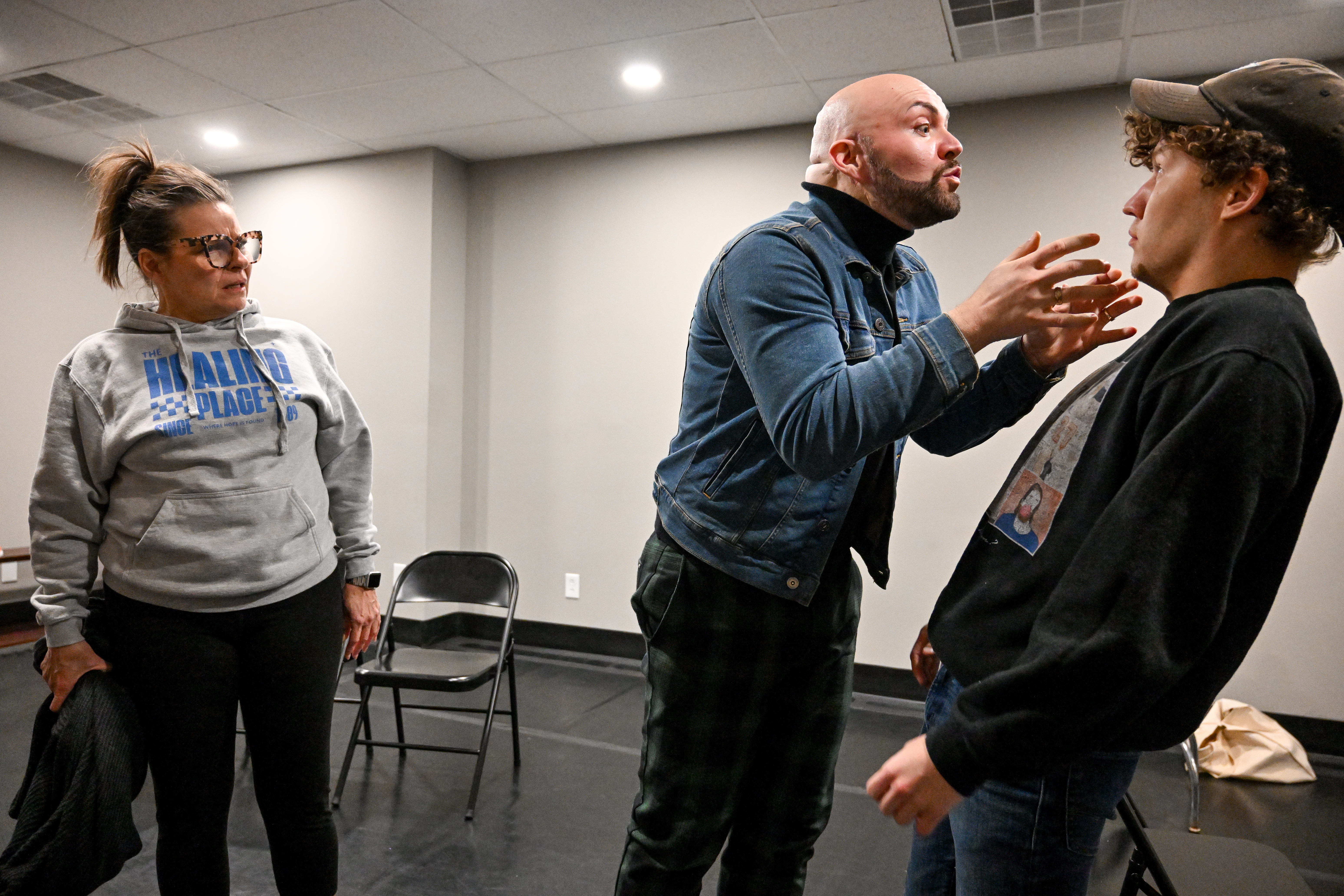
Director Joe Ferrell with Wesley Nelson and Sherry Jackson Thompson
Every character in the story articulates their personal stake in the complicated search for happiness. The social rules are changing, and they are adapting as well as they can. What remains most remarkable about “Torch Song” is how it portrays gay life not as separate from but inextricably related to society at large. And how forces that threaten to tear us apart, like fear, mistrust and heartache, can ultimately bind us together with love, understanding and humor.
“I saw the original Broadway production in the 80s,” Ferrell recounts. “I found it to be so compelling and necessary and fundamentally talking to all of us as human beings. I’ve carried a desire to direct it for a long time and when ActOut called and said, ‘Would you do this?’ I said, ‘Boy, would I!’ These plays really have something to say, and to say to all of us, gay or straight.”
As Sherry Thompson, who plays Ma Beckoff, puts it: “We are living in a time of great upheaval, where trust is hard to come by and curiosity is discouraged. I hope that audiences will come see the show and be replenished, renewed and reminded that art isn’t political…it’s personal.”
