

-
0:00/18:07
" The thing about Jay, which was really amazing, is that the through line between his singing and songwriting and the things that become his narrative impulses in art-making share so many of the same qualities. They're funny. They're tender. They're surreal. They're heartbreaking on some level. They're very much about identity and being, families, love, fatherhood, childhood. Those were the things that kind of drove him. And so no matter what form his work was taking, you could tell this is a Jay Bolotin thing.” — Stuart Horodner on Jay Bolotin
The Many Mediums of Jay Bolotin
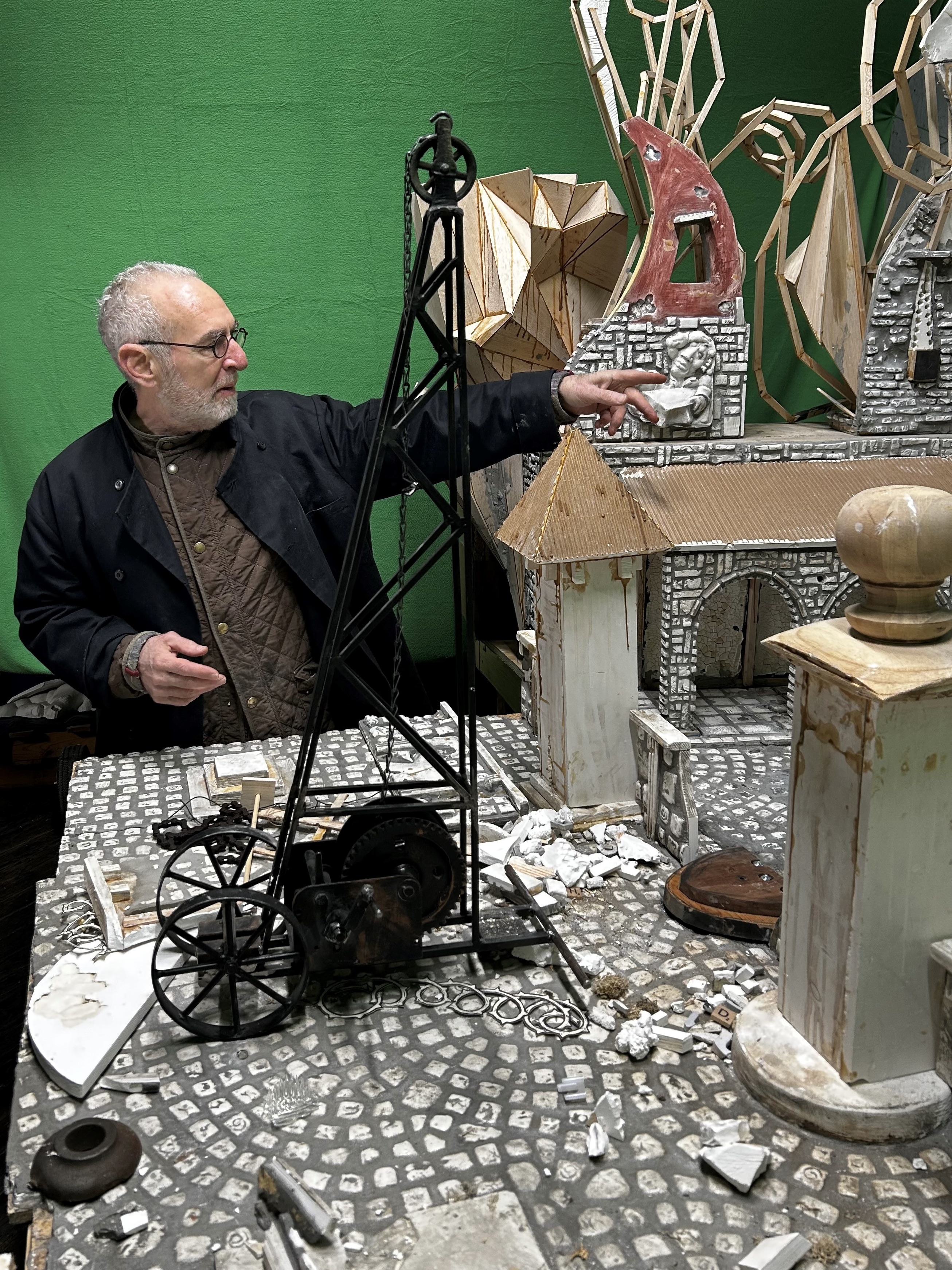
Jay Bolotin in his Cincinnati studio, 2023. Photo credit: Michael Solway.
In an interview for WEKU's Eastern Standard, Art Shechet and UK Art Museum Director Stuart Horodner discuss the Jay Bolotin exhibit opening on January 17, 2025. You can listen and read along. The transcript below has been edited for clarity and flow.
Art: The UK Art Museum has an exhibition opening on January 17th of 2025, titled “Jay Bolotin: A Jackleg Testament,” featuring the work of Kentucky-born artist Jay Bolotin. This exhibition had been long in the planning. Full disclosure, I provided some of the funding for this exhibition.
Stuart: And we thank you.
Art: Happy to do it. But sadly, the circumstances of the exhibition changed this year with the death of the artist in May in the midst of working on his latest projects for this exhibition. Before we get into the particulars about the show, Stuart, tell our listeners about Jay Bolotin, the exhibiting artist.
Stuart: I met Jay soon after I came to my position as director of the Art Museum. It might be interesting to know that Jay had been in dialogue with our former curator Janie Welker. He would be…whenever he had a new project or a new portfolio of prints…he tended to sort of hit the road and try to show what he was up to to various curators, people that he knew, other artists, potential patrons and collectors. And he really impressed the hell out of me. He had works in the collection at the Art Museum, but we had never really done a big project with him. And it was very funny. When I met him, Janie had said, "Well, he's coming in on this day. He wants to bring this new portfolio." Basically the story of this character that he had invented, Only Enoch. It was a series of woodcuts and intaglio etchings. And I said, "Well, that's great. I have about a half an hour to meet with him. That would be wonderful." And three hours later, we were still going at it. I had met some pretty amazing artists in my life and have worked with many. Jay was a kind of one-of-a-kind person.
Art: What was Jay Bolotin like as a person?
Stuart: So Jay was very self-possessed, in a way kind of quiet. You were one of those people that when you're in his company, you were forced to kind of lean in and pay attention. He spoke quietly but strongly. I mean, a brilliant guy. I should say that one of the things that impressed me upon meeting him was the fact that he knew how to do so many things masterfully. I mean, he grew up in Lexington. He was primarily a self-taught artist, although he studied briefly at the Rhode Island School of Design.
Art: He grew up on a farm outside of Lexington, right?
Stuart: Yeah.
Art: In a Jewish family.
Stuart: In a Jewish family, in a kind of agrarian world. And he was interested, even as a young person, in stories, in songs, in kind of narrative traditions. Once he started reading, he was a voracious reader. He was interested in oral histories and various traditions and things that get passed down from people, and he became one of those kinds of people. Like many — let's use the word outsider artists — or self-taught, untrained artists in terms of the academy, he went where his passions took him. So he became quite skilled as a musician, as a singer, as a songwriter.
I think from a very early age, he was embedded in the idea that his work and his purpose was to create and tell stories. In a way, he chose media, whether it was writing and singing, whether it was drawing and sculpting, then later becoming a masterful printmaker. All of that was at the service of using words, using language and using images.
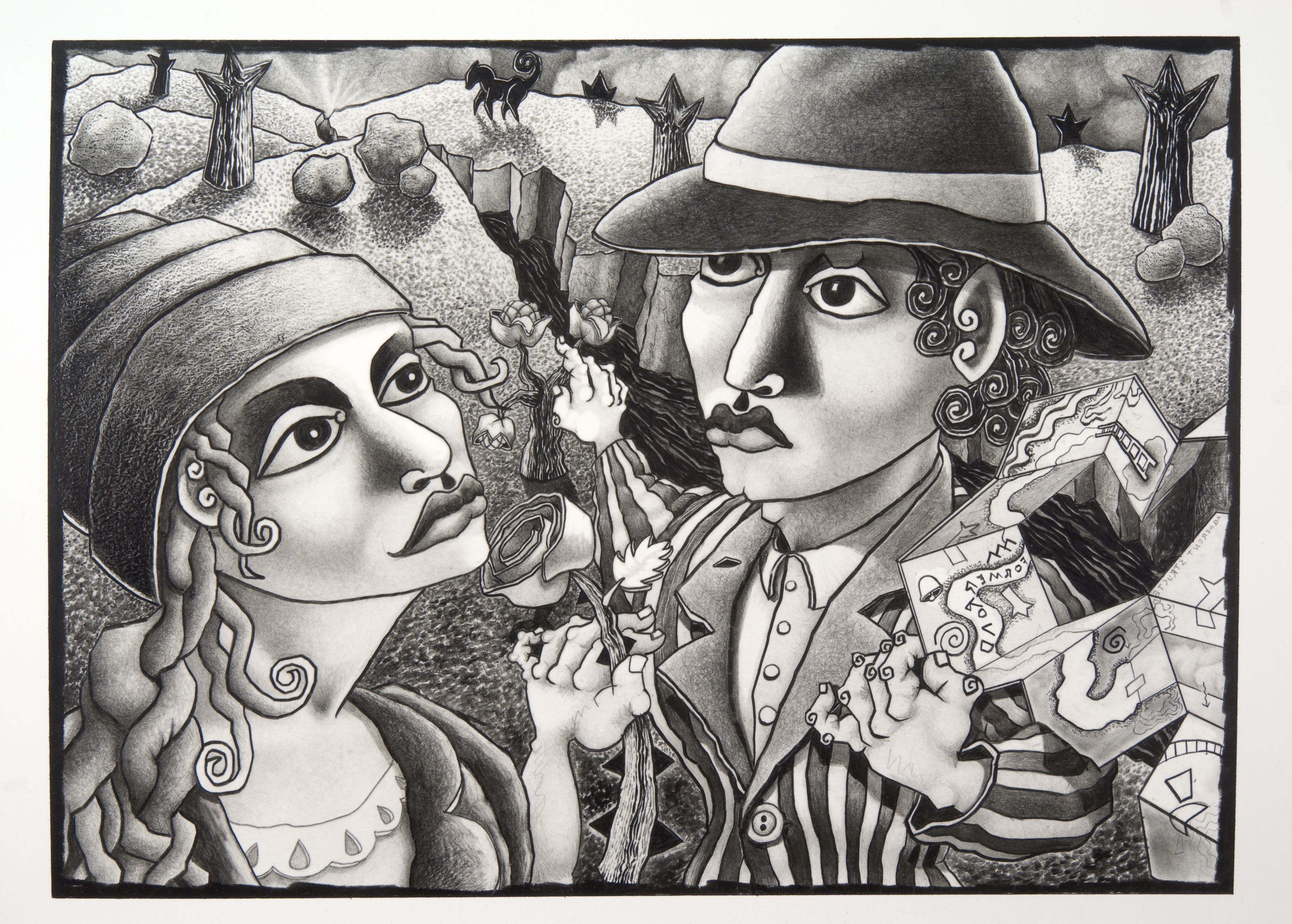
Jay Bolotin, “The Narrator and the Willing Girl." Courtesy of Laura Lee Brown and Steve Wilson, 21c Museum Hotels
Art: He had some success actually early on as a singer-songwriter in Nashville, didn't he?
Stuart: Yeah. He moved there in the '70s and became part of a circle of like-minded singer-songwriters. Merle Haggard, Kris Kristofferson, Rita Coolidge, people that embraced him as a peer, people that really liked what he was doing. His works were — I don't know that they were commercial in a way that Jay's music and his stories were just quirky and didn't exactly fit into kind of mainstream storytelling.
Art: Although Dan Fogelberg had a hit song with one of his songs. (Click to listen)
Stuart: He did. And the thing about Jay, which was really amazing, is that the through line between his singing and songwriting and the things that become his narrative impulses in art-making share so many of the same qualities. They're funny. They're tender. They're surreal. They're heartbreaking on some level. They're very much about identity and being, families, love, fatherhood, childhood. Those were the things that kind of drove him. And so no matter what form his work was taking, you could tell this is a Jay Bolotin thing.
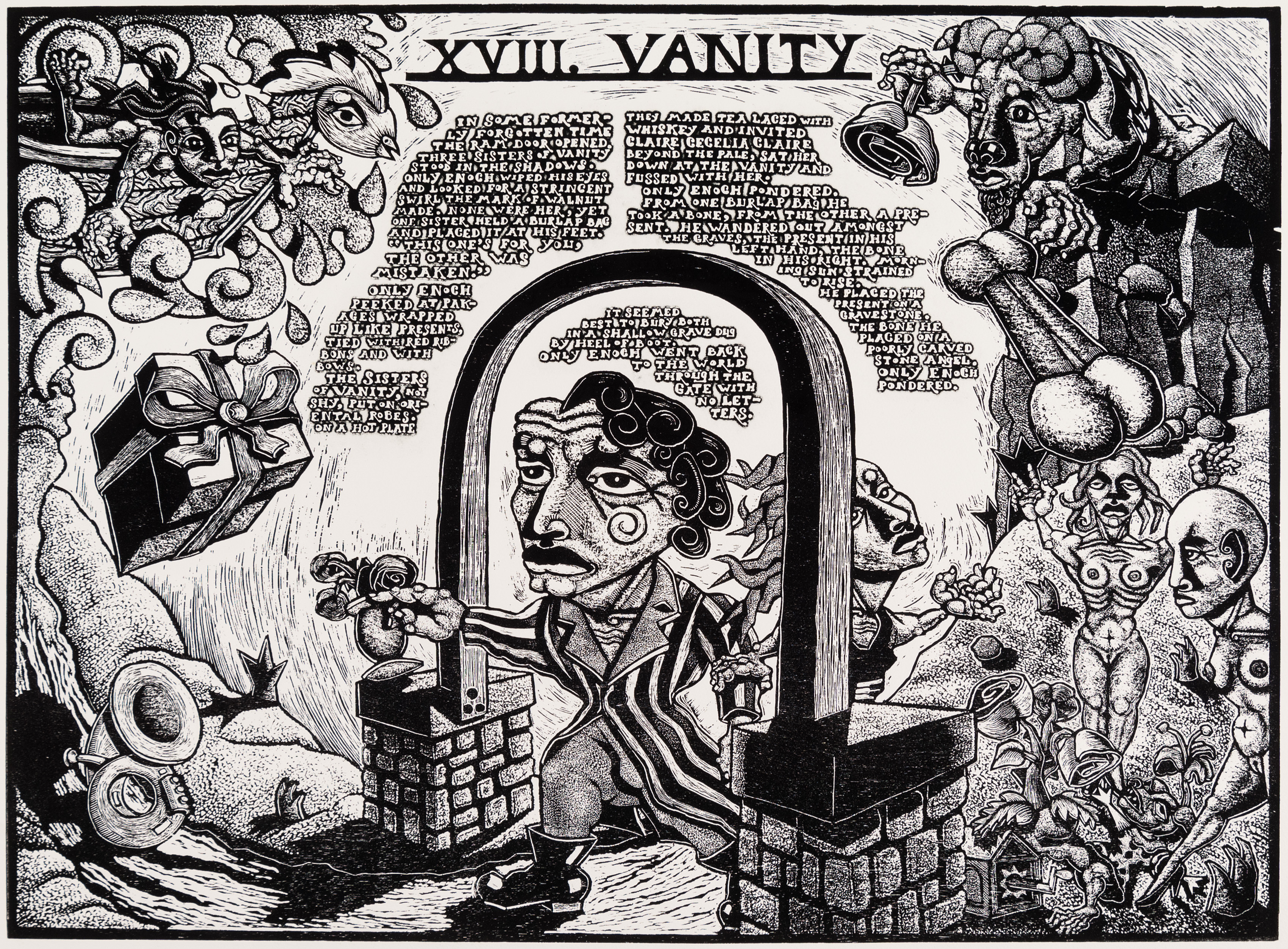
Jay Bolotin, Vanity from The Book of Only Enoch, 2011–14. Courtesy of Solway Gallery.
Art: Printmaker, sculptor, filmmaker, singer, songwriter, composer. I think for his first film, he wrote an opera piece. And it seems that Jay's creativity was boundless. What are some of the things that really stand out to you about his creative processes across all of those modalities?
Stuart: Well, I mean, the first thing is, I think, a question around what defines somebody's drive and ambition. Visiting Jay's studio in Cincinnati several times was not only like a once in a lifetime kind of treat, but you were very aware of the work ethic behind this person. So this was a guy who went into the studio, worked 15-17 hour days, was really the only person who could create the materials that connected to the ideas that were in his head.
He also, I should say, I think was a kind of natural-born collaborator, as much of the studio work was isolating and kind of one-man band. He worked with colleagues who were helping him build sets and occasionally helping with working on plates for printmaking, certainly all of his work in music and in theater. You mentioned this opera, building sets and working with musicians and lighting people. Jay performed all over the world and was kind of a known person. He had time in New York, he had time in Nashville, he went to more dominant art centers, but his daily life was really in the studio in Cincinnati.
One of the things that should also be said, because I think it's important to know how people sustain a life, was that he really early on had a deep connection to the Carl Solway Gallery. And now that Carl has passed on, Michael Solway — I mean, he worked for decades with Carl and had exhibits there — Michael was just telling me the other day the story about Carl visiting Jay in his then studio and seeing these amazing drawings, but also encouraging Jay to look into printmaking because it was a way of making multiple images. It was a way of potentially creating things that might be easily more sellable, more shareable, printmaking obviously being something that has multiple parts of an edition. And when Jay starts tackling printmaking, he doesn't go modest. He goes, let me make four and five foot woodcuts, some of which we have at the museum and some of which will be on view during this exhibit.
So when Jay did things, he was all in. And even if he didn't know about exactly how to make it, how to do it, he could teach himself how to do it, including all of the digital technologies required to become an animated filmmaker.
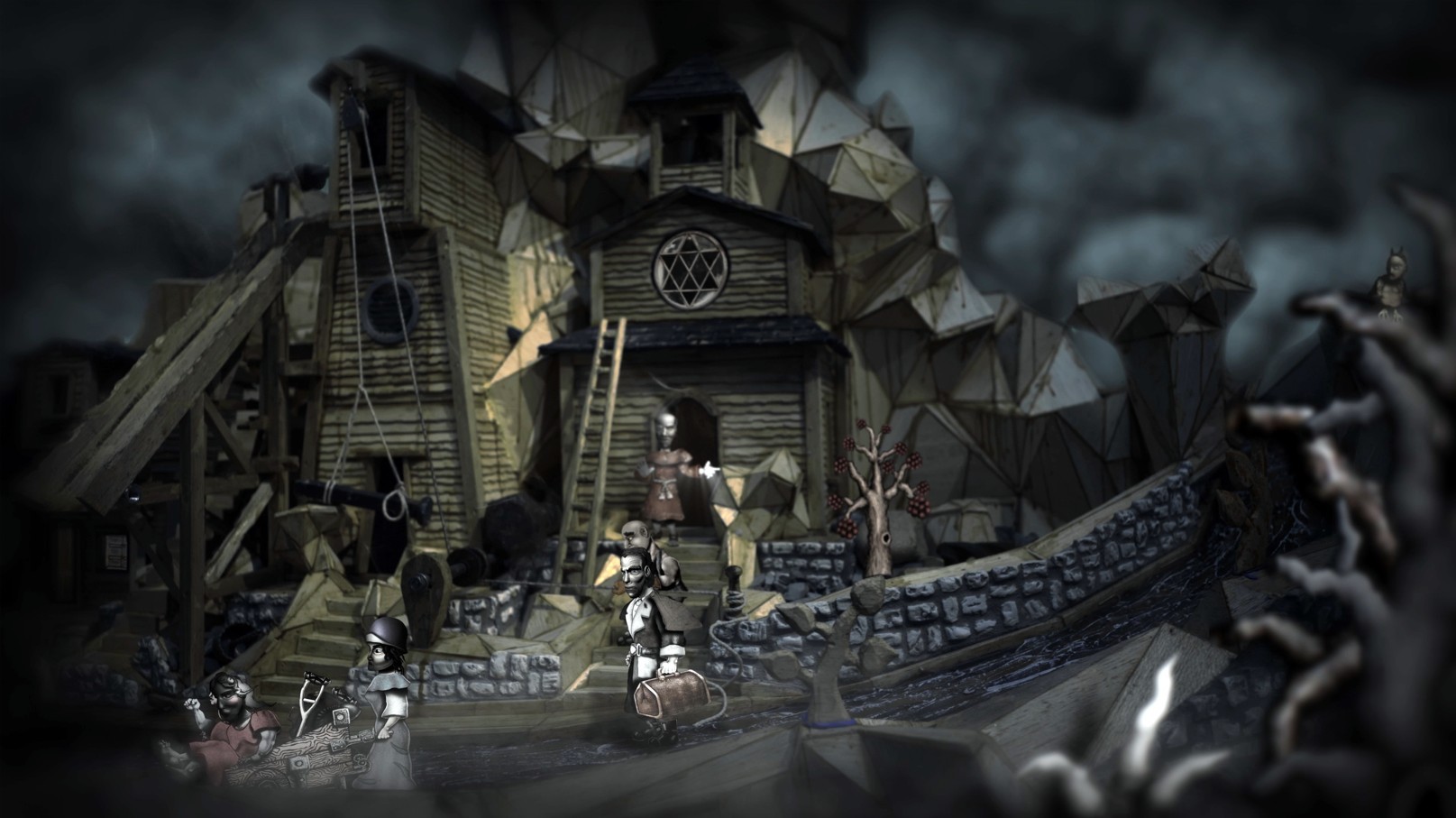
Jay Bolotin, Appalachian Village (Narrator Entrance), film still from The Jackleg Testament, Part 2: The Book of Only Enoch, 2024. Courtesy of Solway Gallery.
Art: When I visited with you in his studio one time, it was like entering a whole other world. It was a created world that began after the door closed, and it was just Jay's world that he was creating in that studio space.
Stuart: And a lot of it was, and this is sort of maybe something that should come up in discussion of the idea about what is available to us now that Jay has passed away, is that even when Jay was alive and even when you're talking with him, there was always a sense that he's the only one who really knows what all of this narrative, this kind of epic story that he was telling with multiple characters, multiple parts, pasts, futures. That he was really the only one who knew in the end what all of it was about and what all the connections were.
I recently wrote and I think mentioned to you that I really feel like while we can situate Jay in dialogue with other artists; it's maybe even more apt to connect him to people like Tolkien's Lord of the Rings or George Lucas and “Star Wars,” as well as Henry Darger and his exploits of the Vivian sisters or an artist like Matthew Barney, creating unbelievably inventive characters and stories and multi-part narratives that you have to watch nine films to be able to understand where all of this winds up.
And so Jay's work, I think, it's very available. You can get a lot out of it by looking and not worrying about whether you know where it all leads. But certainly, the film that he was working on tirelessly in the last couple of years and we had hoped would finish before the show, that's the piece that's never going to get seen. And that's the sort of sadness that hovers over this is that while we're going to celebrate Jay's creativity in a very big way and show his movement from printmaking to drawing to sculpting to set making to film, we're not going to get to see this final film.
Art: Yeah, when Jay died, he was working on the movie “The Jackleg Testament, Part 2: The Book of Only Enoch.” And of course, he's referencing there the Book of Enoch, which was a noncanonical part of the Apocrypha that's obscure and that most people probably know very little about. But he sort of went with it and crafted a whole other story to go with his idea. And he had his other film, “Part 1,” is “Jack and Eve,” his riff on the Book of Genesis, really. So, his animated films, what are they like? What do viewers see in those animated films?
Stuart: Well, I mean, the first thing that I think you see, and we'll have some clips from the first animated film, which is the one you just mentioned, “Jack and Eve,” which is, according to Jay and others, the first full-length woodcut movie, which was Jay's impulse to take a woodcut portfolio that he had made with these characters, Eve and Jack — who is a jack-in-the-box — who in a way tries to lure Eve away from Adam in the garden and offer her a different trajectory. And so he created this entire portfolio and the portfolio was then used, flora, fauna, architecture figures, to be cut apart and used for animation, which was, in a sense, stop-action animation. So, a kind of brilliant idea. He's already got the raw materials. He uses it then to make this narrative. He then got more sophisticated as he became more aware of film technology, animation histories and what the digital would allow him.
So then he starts to say, okay, not only can I draw hundreds of drawings, which will give me the component parts of bodies, clothing, situations, expressions, hand gestures, all of that, but now I'm going to create, against green screen technologies sets, elaborate sculptures made of balsa wood and plaster and cobblestones and streets. I referenced it recently as feeling like “The Cabinet of Dr. Caligari.” It has a kind of German expressionist feel. It's wonky. It's angular. Yes, the houses are stable, but you might not want to walk down the hallway.
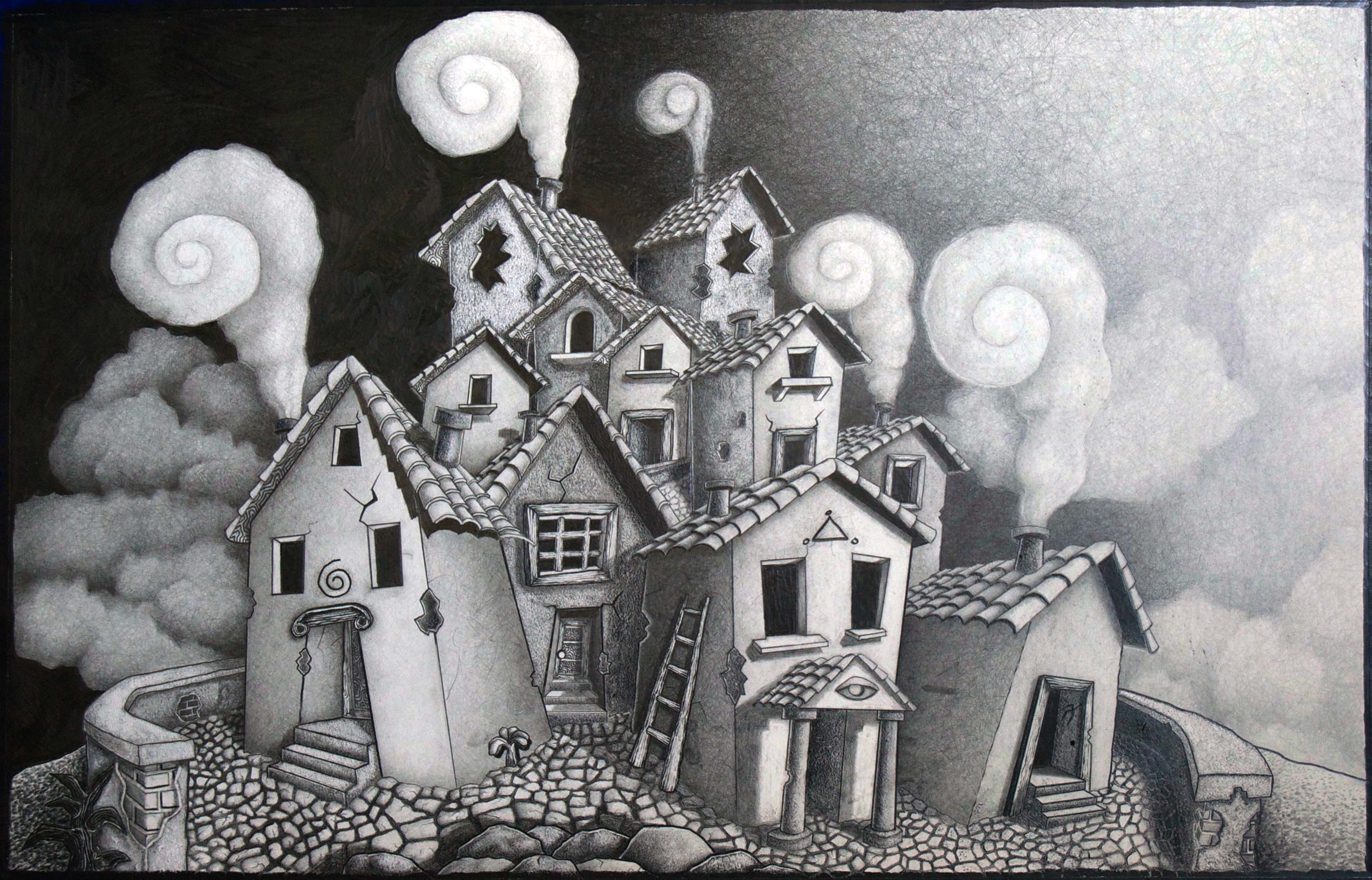
Jay Bolotin, “Some Houses of Only Enoch,” 2015, graphite on illustration board. Courtesy of Solway Gallery
There is this very unstable anxiety-producing quality, which I really believe. And Jay was a big fan of people like Kafka and Bruno Schulz and writers who addressed 20th century horrors and feelings of anxiety and the human being against the state and the human being against history and a kind of Jewish anxiety maybe as well. And so he creates these worlds in which anything can happen. There's a kind of gray moodiness to the way the sets and the figures move. They're on journeys of self-discovery and wonder in terms of what happens in the narrative.
I think “Star Wars” and “The Hobbit” and some of these things that we feel very comfortable talking about as multi-part epic situations, it was all in Jay's head, and his life's work was getting it out of his head into a form that others could share. So I think what you're going to see when you come to the exhibit — and we've unpacked it in a way that I think is very followable — is you see him making prints, you see him animating those, you see him building a bit grander vision for what can be in a single frame of one of these moments in a film, which could be the set, the figures moving, smoke, fire, birds flying over.
This is where the collaboration thing kicks in because he decided that not only would he score most of the music and voice one or two of the characters, he would engage people like the actor Brad Dourif, one of his favorite actors, and Will Oldham, the musician and performer from Cincinnati.
Art: Bonnie "Prince" Billy.
Stuart: Other theater performers and regional talents. And these were people that he solicited by sharing his work with them, asking whether they would collaborate, often trading work with them for their services. And so sound and voice that are seen in this film that we will be showing sequences from are spoken by and acted out by some of these amazing people that Jay solicited. And he was fearless in that regard, which is one of the things I love the most about him. He'd get in a car and drive across the country to go to Los Angeles to meet with the actor Michael York because he was convinced that Michael needed to play a puppeteer in his movie. And that didn't pan out because of Michael's health, but like you're this 70-year-old guy, you get in your little car with your portfolio and some moxie and you drive to California or Woodstock to meet Brad Dourif, one of his acting heroes, and try to just convince the guy to participate.
Art: He was a generous artist. He wanted to share his world with everybody and draw lots of people in.
Stuart: And I think people, once they met Jay and saw the magical aspects of what he was doing, they felt privileged to be in this service with him. I think by the time you leave, you'll have an amazing sense of what this person's accomplishment really was.
Art: Thanks again for coming down, Stuart, and talking with us. This sounds like a really exciting exhibition. I hope that lots of folks get there. Thanks again for coming.
Stuart: My pleasure.
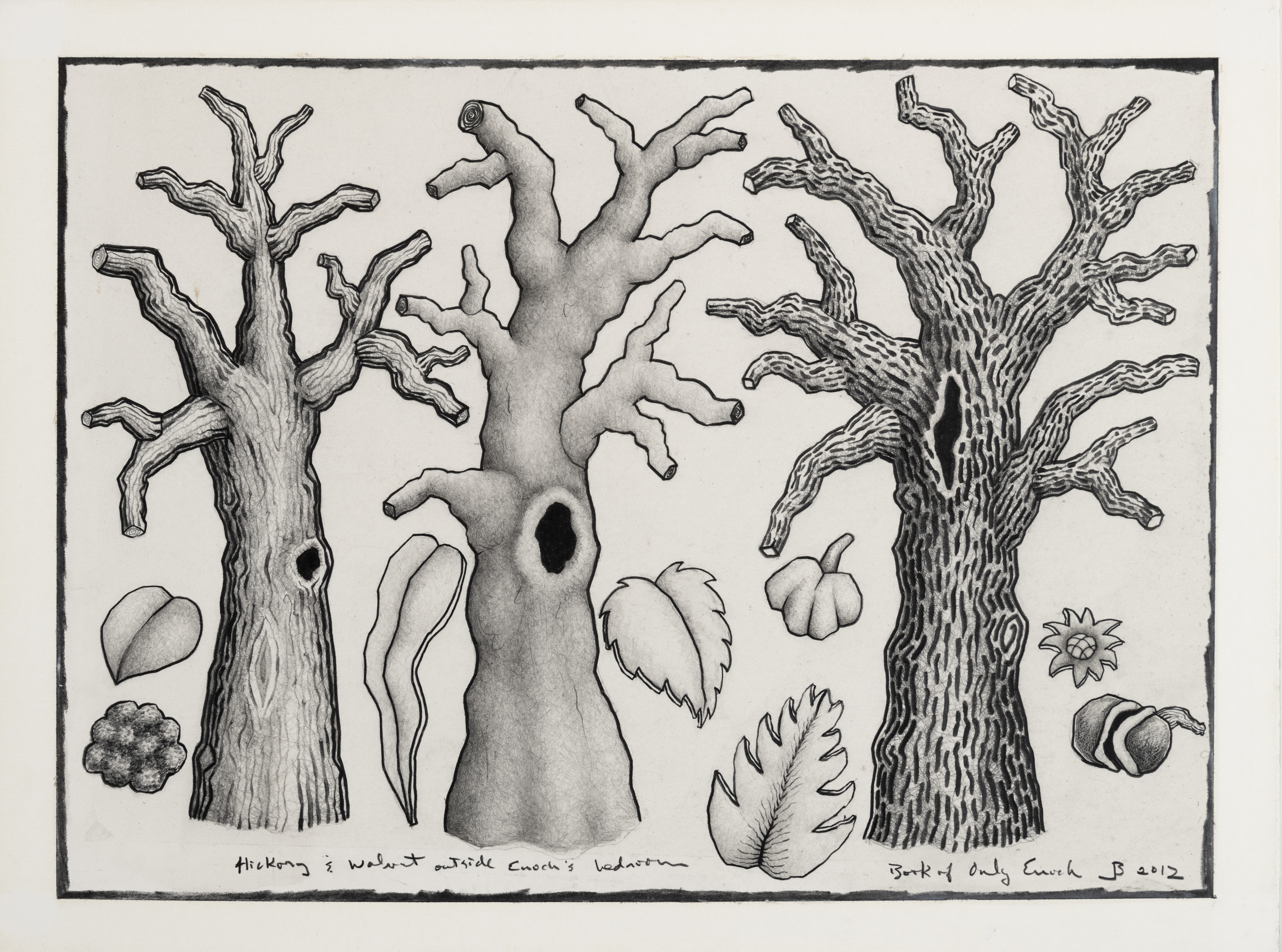
Jay Bolotin, Hickory & Walnut Outside Enoch’s Bedroom, 2012. Courtesy of Michael Solway.