

“I just never really heard anybody play the way Miles does. His sound is really inspirational. The players I gravitate to the most are ones that don’t sound like anybody else. I think you can hear some of Miles’ influences, but he’s always himself when he plays.” — Jacob O'Donnell
Miles Osland: Versed, Visible and Versatile

Miles Osland, director of jazz studies, professor of saxophone at UK (Credit: Damien McClean )
By Walter Tunis
Time has a funny way of shifting one’s perspective on — as well as placement in — life.
Our featured example: Miles Osland. He is perhaps the most versed, visible and versatile jazz artist in Central Kentucky, but one whose professional career is based around his role as an educator. When Osland began teaching duties at the University of Kentucky in 1989, he rightly viewed himself as the new kid on the scholastic block.
But Osland was also a profoundly learned saxophonist with an eagerness and drive for stage performance that he readily brought to his new position. That meant integrating himself into the classical as well as jazz programs at the College of Fine Arts.
In short, Osland wanted to make some noise.
“When I got here, I was absolutely the new guy, eyes wide open. I remember catching Phil Miller, who was the director of the orchestra at the time, in the hall. This was during my very first semester. I said, ‘Hey Phil, do you have any repertoire that’s going to have saxophone in it for the orchestra with your concerts this semester?’ He just looked and me and said, ‘And you are...?’”
But as Osland started his 36th year at UK this fall — where he is now director of jazz studies, professor of saxophone and the guy responsible for landing performances for the school’s numerous jazz groups at many leading national conferences and initiating a seemingly endless list of recording sessions that have forever documented their music — the tables have very much turned.
“It’s funny, because I’m the old guy now. There are so many new faculty members. We just had a faculty meeting this afternoon and I’m practically doing the same thing. ‘And you are...?’”
Always on a mission
Local audiences can attest to the openness of Osland’s artistry in performance, whether it is with one of his groups or any of the student ensembles he conducts. But to measure the sheer stamina of that spirit, talk with some of the students that are now making music on their own after studying with Osland.
“His work ethic is incredible,” said saxophonist Kirby Davis, who earned his master’s degree from UK in 2021. Now an adjunct music instructor at Kentucky State University and a visiting instructor at Centre College, Davis also plays regularly in Lexington with Tee Dee Young and Lee Carroll.
“That work ethic makes its way to the students, too. He’s just completely focused, day to day. Miles is always on a mission, whether it’s teaching, conducting ensembles or arranging opportunities for his students. You see Miles throughout the day and he is working on something constantly. He’s going somewhere. He’s on the phone. He’s constantly making things happen.
“Rehearsals were always like that like, too. It’s just straight to business. You can get kind of get lost in it, but he helps you get to another level of productivity that you might not have gotten to if he weren’t in charge.”
“I just never really heard anybody play the way Miles does,” said saxophonist Jacob O’Donnell, whose dossier includes gigs with The Baja Yetis, Movie Jail and his own trio as well as with Carroll and Young. O’Donnell met Osland while playing in the Henry Clay High School Jazz Ensemble and went on to study with him at UK.
“His sound is really inspirational. The players I gravitate to the most are ones that don’t sound like anybody else. I think you can hear some of Miles’ influences, but he’s always himself when he plays. I caught that when I first heard him in person. And as a bandleader, he is super confident.”
Few Lexington artists have worked more extensively with Osland than pianist Raleigh Dailey. Doctorate studies with Osland at UK beginning in 1998 led to performances in the UK Jazz Ensemble. When a teaching position opened, Dailey and Osland became collaborators in and out of the classroom. The latter included playing in everything from duo settings to combo and orchestral collaborations, usually with Dailey’s compositions forming the core of the repertoire.
The Osland-Dailey Jazztet with Raleigh on piano, Miles on saxophone, Danny Cecil on bass, Paul Deatherage, drums and featuring critically acclaimed New York saxophonist Rudresh Mahanthappa, who visited Lexington in 2018 to play a concert with the Jazztet.
“I walked into Miles’ office when I first came to UK,” Dailey recalled. “He wanted to see if I could play, basically. He had a drum set in his office in those days, so we played a piano/drums duet. After that, he said, ‘That’s cool. I’ll start to get you on some gigs.’ That was my first meeting with Miles. When a teaching position became available, we became colleagues and collaborators and it’s kind of gone from there.
“I still don’t know anybody that works harder at what he does. It’s really, really inspiring. He seriously goes for it. If he decides the Jazz Ensemble is going to play on the moon next year, he’ll figure out a way to make it happen.” (A special Raleigh Dailey treat awaits below. Be sure to click on “INFO.”)
A career in record time
Ask Osland about the accomplishments he is most proud of during his three-and-a-half-plus decades at UK and one word immediately surfaces: documentation.
In this case, that translates into CD recordings — commercially cut and promoted documents of every facet of his professional life. There are albums made with the UK Jazz Ensemble and saxophone groups along with small group and jazz orchestra sessions that have incorporated fellow faculty members along with musicians from around central Kentucky. It’s a massive list — 45 recordings in 35 years.
“If you look at it from a research aspect, I mean, that’s why I’m full professor. This is my creative research — aka, CDs that I’ve been on or have directed a student ensemble or a professional ensemble for. Basically, it’s documentation of what I am as a musician and an educator, especially the Jazz Ensemble CDs, the Mega Sax (saxophone group) CDs and so forth. I’m really proud of those. We keep pumping them out.”
Playing with Vince
Osland came to UK from the Eastman School of Music, where he earned his master’s degree in jazz and contemporary media. His summers there brought him into the orbit of trumpeter Vince DiMartino, who at the time was in the home stretch of his tenure leading the jazz program at UK and the school’s critically acclaimed Jazz Ensemble. DiMartino came to Eastman during the summer months to work with its Arranger’s Orchestra.
But this was hardly a simple succession. Even after DiMartino left to teach at Centre College in Danville, he and Osland remained close personal and professional friends. The alliance led to the long-running DiMartino-Osland Jazz Orchestra, a massive musical enterprise the saxophonist has long referred to as simply DOJO.
But as was the case with his graduation from new kid to learned veteran at UK, a similar role reversal has emerged within in his musical partnership with DiMartino. The reason? The trumpeter, long retired from Centre, now resides in Florida. In other words, while it was DiMartino’s inspiration that brought Osland to Kentucky at the end of the ‘80s, it’s now Osland who is trying to entice DiMartino to come back home — or at least to visit often enough that DOJO can remain active.
“The inspiration of just being able to play with him is still huge, but a lot of my inspiration now with Vince is trying to twist his arm to get him back to Kentucky. Like, I get him back now for maybe one or two summer gigs."
DOJO last played in Lexington in July as part of Ecton Park’s long running Big Band and Jazz Series. Osland said contracts are in place, though, for a performance at Georgetown College in March.
“I like to think of Vince as good, fine wine. He gets better with age.”
Following the flute
So where did everything start for Osland? What artist turned him on to a life in jazz?
Well, brace yourselves. It wasn’t a saxophonist. More than that, Osland’s first-love instrument wasn’t even a saxophone.
“When I was 10 years old trying to decide what instrument was for me, my mom played me a Paul Desmond recording for saxophone and a Pete Fountain recording for clarinet. And then she gave me this real hip — for the ‘60s, real hip — Herbie Mann record. That’s what caught me, man. Herbie Mann, at that time, was kind of like the Kenny G of flute. Man, that guy could really play.
“It wasn’t Memphis Underground (Mann’s groundbreaking 1969 album that fused jazz with rhythm and blues). That was kind of like the second one I thought was really hip. The first one was The Beat Goes On (a more Latin leaning 1967 album that boasted such celebs as Clark Terry, King Curtis, Joe Zawinul and Roy Ayers). And it was specifically that tune, ‘The Beat Goes On’ (a jazz reimagining of the song Sonny and Cher made into an AM radio hit only months earlier) that my mom played. It had this very hip ‘60s boogaloo beat that he just killed. I mean, it was such a great tune anyway.”
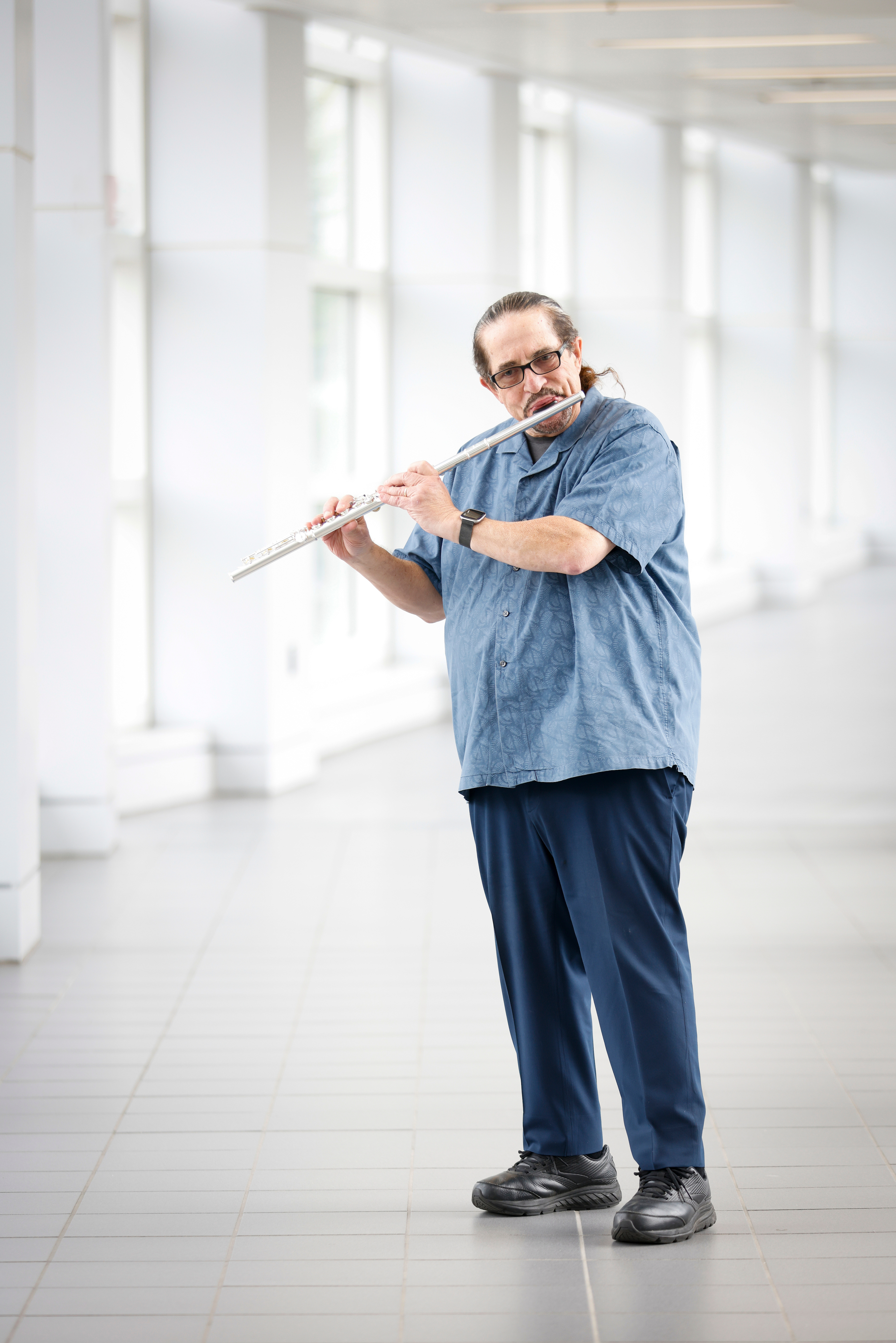
Miles Osland (Photo by Mark Cornelison)
Get set for another full circle moment as Osland has recently renewed his fascination with the flute, so much so that he is now a Tomasi Artist, an endorser for instrument makers Tomasi Flutes of North America.
“Yeah, I’m the saxophone professor, but I’ve always really considered myself a flute player because flute was my first instrument. I’ve been playing a bunch of flutes lately and am really digging into that more and more. I’m keeping the saxophone open, doing what I do. It’s just that I’m taking more time to reflect on how the flute was really my first love.”
A great team
Think there is only one professor of saxophone by the name of Osland currently teaching and leading ensembles at UK? Think again. Lisa Osland, wife to Miles, is also on the faculty. While she frequently collaborates with her husband on projects, most notably the Osland Saxophone Quartet (a group whose rhythm section-free lineup is made up of soprano, alto, tenor and baritone sax), her performance and educational work regularly carry her over to classical music.
“Lisa and I make a good team in many respects. She is a great classical player who plays jazz very well. I’m a jazzer who plays classical very well. She heads up the classical saxophone quartet and overflow of one-on-one private study here on campus. Then I do that on the jazz side with the Mega Saxes, which are the saxophone quartets and quintets. Most students are doing both. From a small group standpoint, that’s Lisa and I doing what we like to do, working to our strengths together as a team. It’s a well-rounded team effort.
“Yeah, we’re married. But it’s not like we go home after everything and play duets. We go home and watch ‘Jeopardy.’”
And that Raleigh Dailey treat that we mentioned?