

The Surest Things Can Change
Photographer Richard McCabe Captures the Nostalgia of Place

The photography of Richard McCabe is on display through December 21, 2024 at Institute 193 in Lexington, Ky
By Emily Goodman
Contributing Writer
A few weeks ago, I went back to my hometown for the first time in five years. I moved away almost two decades ago and, in that time, I have only spent a few days and weeks in the neighborhood where I grew up. But a few weeks ago, the death of a dear friend's mother prompted me to revisit the area that had once been my home but was no longer.
The trip was haunting. Many of the places I had once frequented felt untouched. Independent shops and staple restaurants had weathered the tides of change, outliving the bigger chain stores that had occupied neighboring lots, only to succumb to the market pressures of the pandemic and its aftermath. Many other sites were dramatically altered, with restaurants and stores changed or abandoned, buildings removed or renovated. The landscape was the same as it had always been and also entirely different, a transformation not unlike the one that I have undergone in the time since I “left home.”
I had been mulling over this experience, trying to understand my connection to and disconnection from my hometown when I attended Richard McCabe’s artist talk at Institute 193 on Nov. 9. McCabe is a photographer and a curator based in New Orleans, although he grew up in the Florida Panhandle. His current body of work — entitled “Perdido” and on display through December — is a photographic rumination on the towns and beaches of Florida’s Gulf Coast, captured as his “connection to the region through [his] mother and family was beginning to slip away,” due to her failing health. The works in the show all play with the tenuous connections that we can feel when the places where we grew up that were once home are no longer that.
Instead of telling a continuous story of the environmental, social and personal changes McCabe witnessed in his various returns to his homeland on the Florida Panhandle, “Perdido” offers the viewer flashes of different spaces and places, taking on a wide array of formats. The result is a multifaceted experience that offers intimacy at some points and distance at others, much like how our own memories exist as a compendium of our own individual experiences and as recollections of shared moments.
One example of McCabe’s ability to capture the nostalgia of a place and the evidence of its change over time is in his checkerboard-like grid of Polaroids that comprise “Perdido Series x 14.” Most of the photographs in this series were taken on the West Side of Pensacola, Florida, the part of town that McCabe frequented in his youth but has experienced significant economic decline in recent decades. Whereas the buildings in these photographs had once been the indicative of the latest architectural trends, given the very distinct midcentury elements that characterize most of them, they are no longer in vogue and are littered with marks of the passage of time.
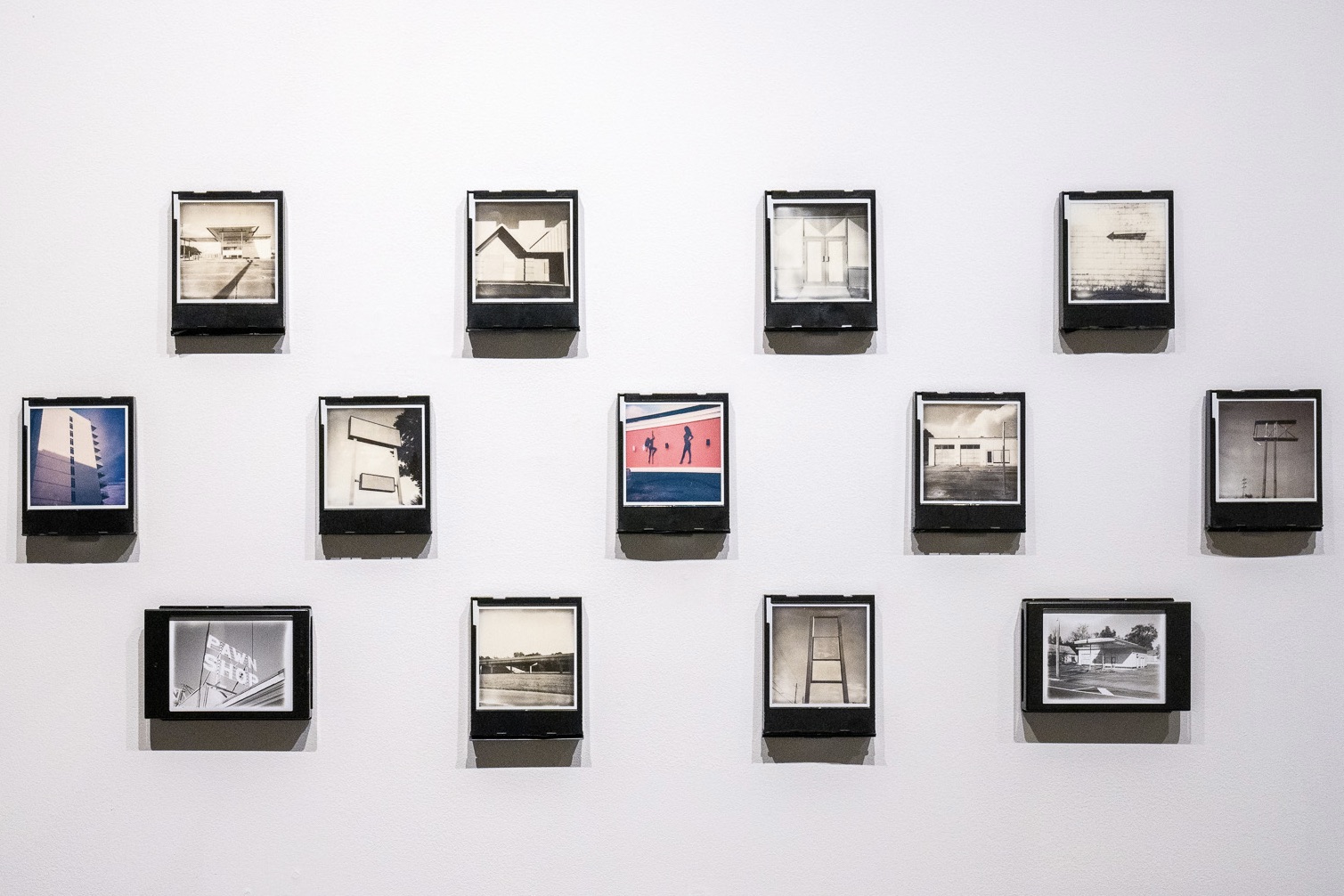
McCabe makes this contrast even clearer by the fact that just slightly to the right of this series he has included two Polaroids of the newer, luxury high-rises that characterize the resort district of Pensacola’s East Side.


These buildings, which emerged long after McCabe had moved away, are more representative of what the region is today, how it is known to its current inhabitants. McCabe has photographed these structures in color, whereas the previous set of images are largely black and white, thereby further highlighting the presence of the new buildings — which appear in the same vibrant hues that we would see them today — and the past of the old ones, whose age is underscored by the affiliation of black and white photography with bygone eras. By placing their image alongside those of the decaying buildings that he frequented in his youth, McCabe makes clear the fact that the city of his memories is no longer the city that exists, a notion that is true for all migrants returning to their homes.
McCabe’s interest in the changing landscape isn’t limited to human structures and manmade transformations. Throughout the exhibition, McCabe incorporates images of the natural environment of the Florida Panhandle. For instance, he includes several seascapes of the Gulf of Mexico in different scales, contrasting the 3.5 x 5.74 in format of a Fuji FP-1000 instant print (a similar format to the Polaroid) in his piece “BLANK” (2024) and the 19.75 x 29.25 in pigment print “Gulf of Mexico,” also from this year. Both images capture the rising sun over the ocean, creating a dazzling gradient of blues, pinks, reds and oranges as the atmospheric light reflects off the water. The difference in scale, however, makes the one feel like a private moment, captured instantaneously, while the other feels more substantial, as if creating a universal portrayal of the sublime in nature, one that can be more easily shared and understood by all who behold it. In both cases, the capturing of sunrise over the ocean highlights how transient time really is. Sunrises are momentary phenomena and they often go unnoticed since the circadian rhythm of the body uses the light after sunrise as an indication that it is time to wake. And yet, while sunrises are fleeting, they are also constant, occurring daily whether or not we observe them, and their occurrence is the clearest marker that time has moved forward since a new day has begun.


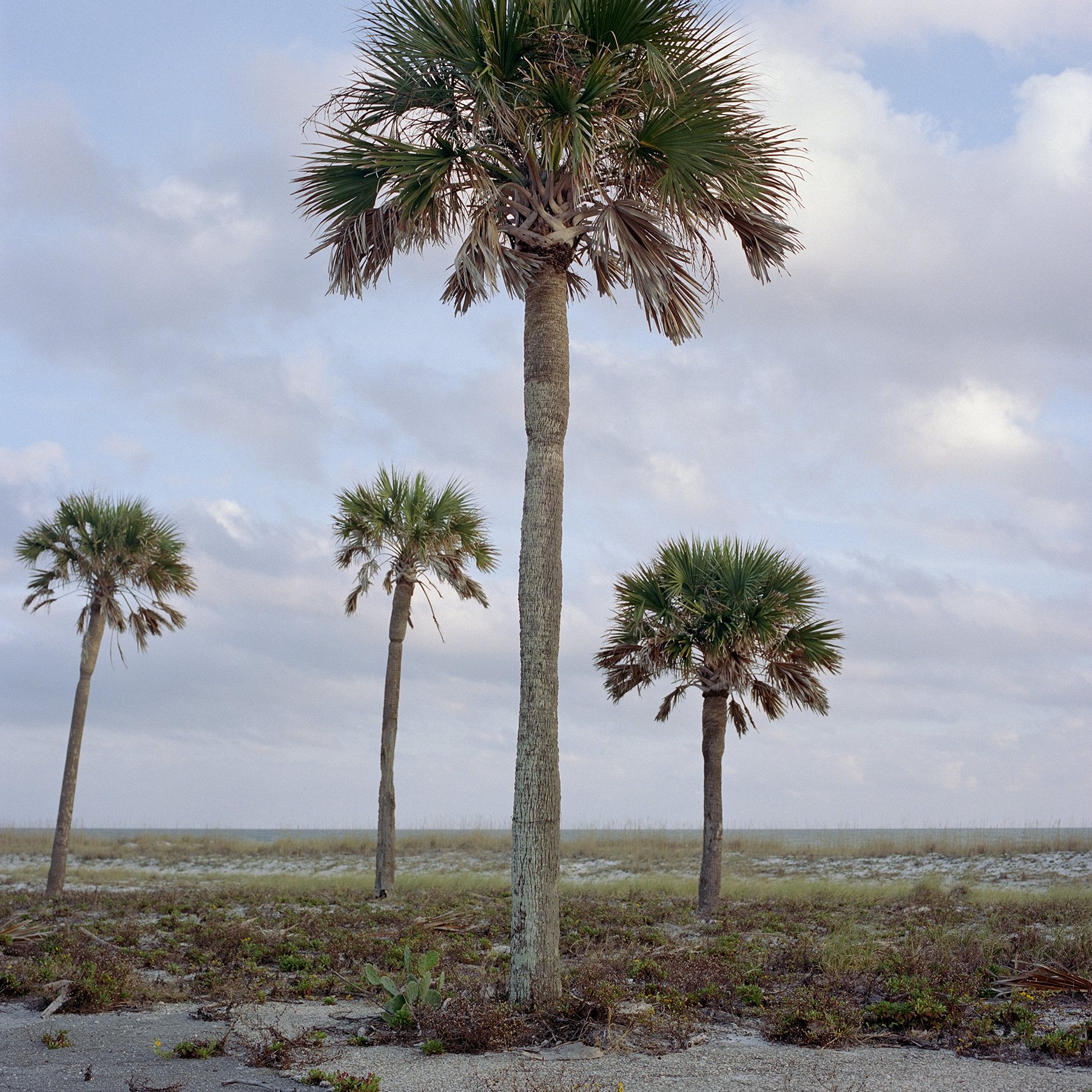
Alongside these images of the ocean, McCabe has included photographs documenting how nature can transform human interventions into the landscape. In the image “Former Site of the Five Flags Inn, Pensacola Beach, Florida” (2020), McCabe captures four palm trees rising up from patches of beach grass. At first blush, this image looks like another open beachscape, just a patch of land along the shore. But upon closer inspection, we can see the remnants of a concrete building foundation, indicating that this is not, in fact, untouched wilderness. As the title clearly indicates, this is the site where the Five Flags Inn, a working-class beachfront hotel, had stood from the 1960s until it was destroyed by Hurricane Ivan in 2004. McCabe has included a color postcard of the Five Flags Inn alongside this photograph to truly underscore how this piece of land had existed in the past and how it does in the present. The transformation, of course, is complicated by the fact that what has emerged in the space where a human structure once was is a natural landscape. As such, McCabe illustrates that what has been in the past may also be in the future, noting that while time clicks along in a single direction, the relationship between history and the present is not always linear.
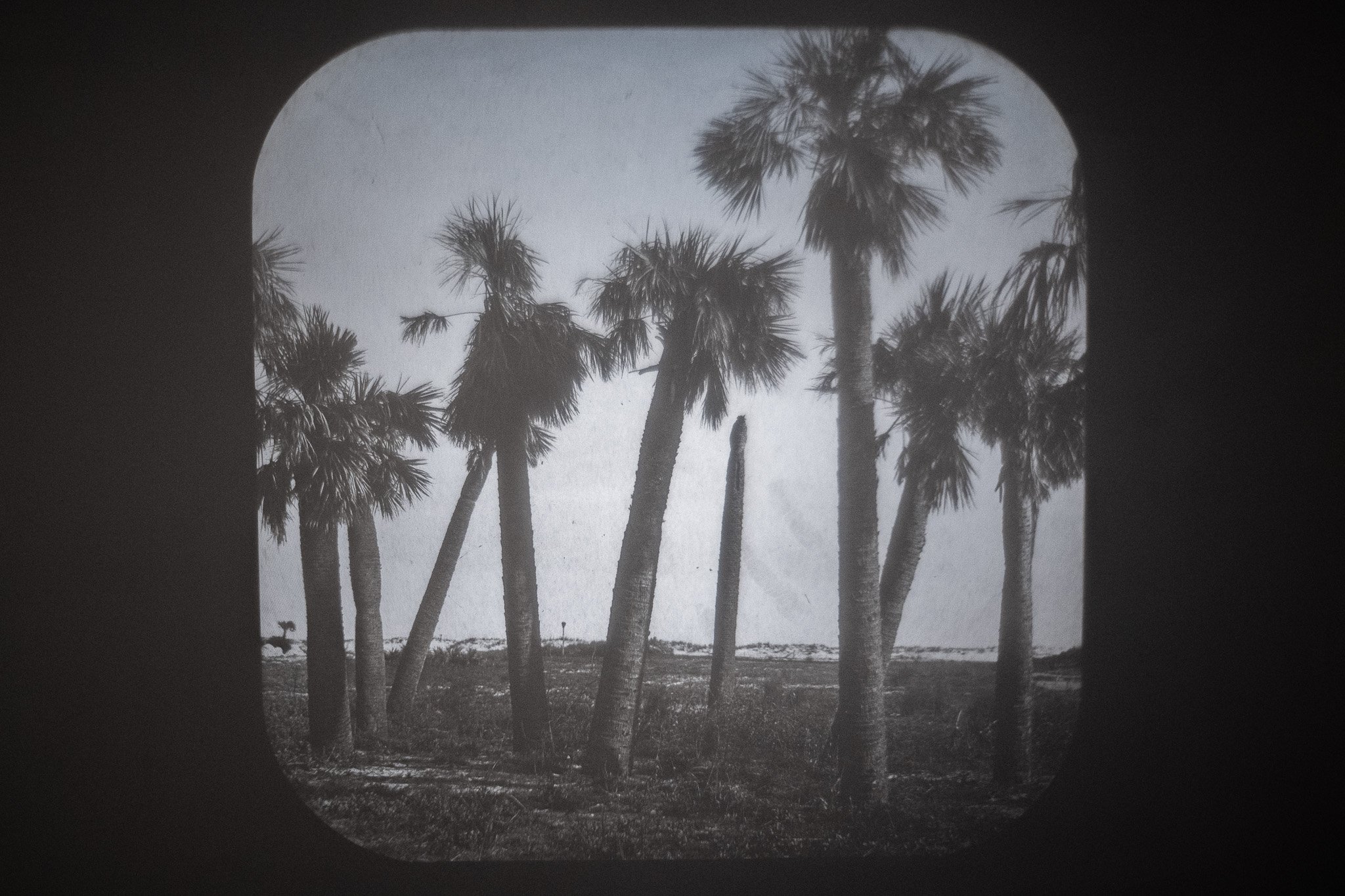
McCabe doesn’t just consider how time passes with regard to subject matter; he also does so in the media he works with. The entire show is comprised of different forms of analog photography, taken with instant cameras as well as more conventional manual SLRs, and he has even included a cyanotype photogram — an image of a pink lawn flamingo created just by exposing the cyanotype to sunlight without any technical equipment, an homage to the earliest uses of photography. And McCabe uses antiquated technologies in the form of overhead projectors and lightboxes in several works as well. In one such installation, “Palms, Pensacola Beach, Florida” (2023), McCabe printed a photograph of several weathered palm trees on a transparency sheet and projected them onto the wall using an overhead projector. The image, which appears in black and white, feels older because of the technology and because trees are intrinsically associated with the ability to withstand the passage of time.
In many ways, the exhibition “Perdido” is an investigation into what is lost, as the name suggests, when we leave a space. The streets and buildings change, characteristics of a neighborhood transform and the sites become something new in each passing moment, making clear that what was once there may not be anymore. At the same time, the emphasis on change in McCabe’s work is not solely nostalgic or melancholy. Throughout the body of work, McCabe is excavating histories from sites and connecting his own personal past to other pasts. By creating physical photographs of the places he once inhabited, he is preserving them as they once were so that past can be understood as a part of the present. And he is illustrating that the disconnect that happens from a space does not have to mean that the life lived there is gone forever. It just means that one person’s position in a space is small in the history of that place and in the history of that person.
What struck me most about going “home” again was how different my perspective was. Having been away for so long made me realize how much the city had continued to change without me and how much I had changed without it. I am grateful for my hometown in many ways and am the person I am today because I lived there once. But I am also the person I am today because I haven’t lived there for almost 20 years, and because of all the places where I have found a new home — like Lexington. And because I am here, I had the opportunity, through McCabe’s photographs, to share in that reckoning over what it means to go home after leaving that home. In his work, I can see more fully the complex interrelationship between place and person that marks us all.
Visit “Perdido” at Institute 193
If you go:
Institute 193 is located at 215 N Limestone, Lexington, KY