

“I was the only person in the world doing this. It was the stupidest, most labor-intensive process ever, but I enjoyed it thoroughly. When I realized that I couldn’t do it anymore, I knew I was going to have find a new way to work. I was going to have to paint like a mere mortal.” — Lynn Sweet
STUDIO VISIT: RIDING THE GREAT GREEN SLALOM
Lexington’s Lynn Sweet fights through adversity to paint Kentucky landscapes

Story and photos by Kevin Nance
Lynn Sweet was afraid. It was 2019, and the bespoke fresco painting technique he’d developed in recent years — in which he would squeeze specially mixed pigment from the tip of a Wilton bag, best known as a tool for decorating cakes — was no longer possible for him. After half a century of woodworking and housebuilding and “mechanicking,” as he called it, the cartilage that formed a crucial buffer in the joint of Sweet’s dominant left thumb had disintegrated. “It hurt so bad,” he recalls now, “I couldn’t put a glove on it.” After surgery the thumb was better, but it could no longer tolerate the repetitive stress of squeezing ridges of paint from a pastry bag. “I was the only person in the world doing this,” he says. “It was the stupidest, most labor- intensive process ever, but I enjoyed it thoroughly. When I realized that I couldn’t do it anymore, I knew I was going to have find a new way to work. I was going to have to paint like a mere mortal.”
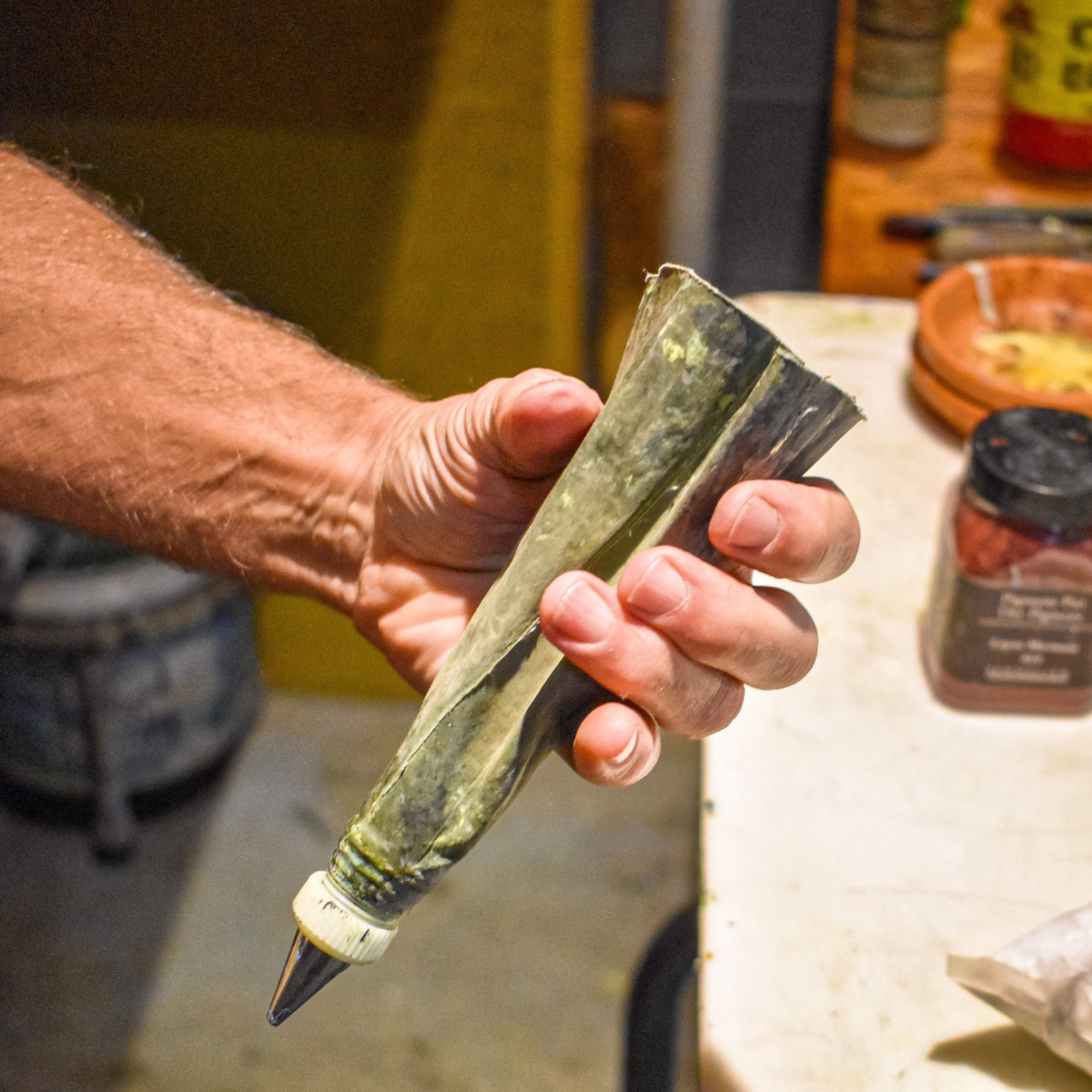
Sweet's longtime partner, the interior designer Julie Rainey, watched his struggle with growing unease. “He felt like his technique was what made him unique,” she says. “He was losing his edge, which was really scary for him.”
For the next year, Sweet focused on making small gouache studies in moleskin notebooks with a brush — “cartoons,” he calls them — for his next series of landscape paintings, not knowing how or whether he’d be able to complete the large-scale versions. But even though he hadn’t done representational brushwork since high school, these early images were encouraging. “It turned out to be like playing the harmonica,” he says. “Once you know, you know.”
And when Sweet finally made his way down to his basement studio to make the large paintings (after a harrowing bout of Guillain-Barré Syndrome, a neuromuscular disease that left him paralyzed for several months in 2021), he felt a surge of hope and excitement. “It was kind of heartbreaking at first, not being able to paint the old way,” he recalls. “But I knew I had to do something. I’m just driven to make stuff.” And soon, even with having to paint in reverse order — creating the background first and then working his way toward the foreground, which was 180 degrees from his old front-to- back fresco technique — Sweet found himself literally salivating at the results he was getting, he says. “It was making my mouth water.”
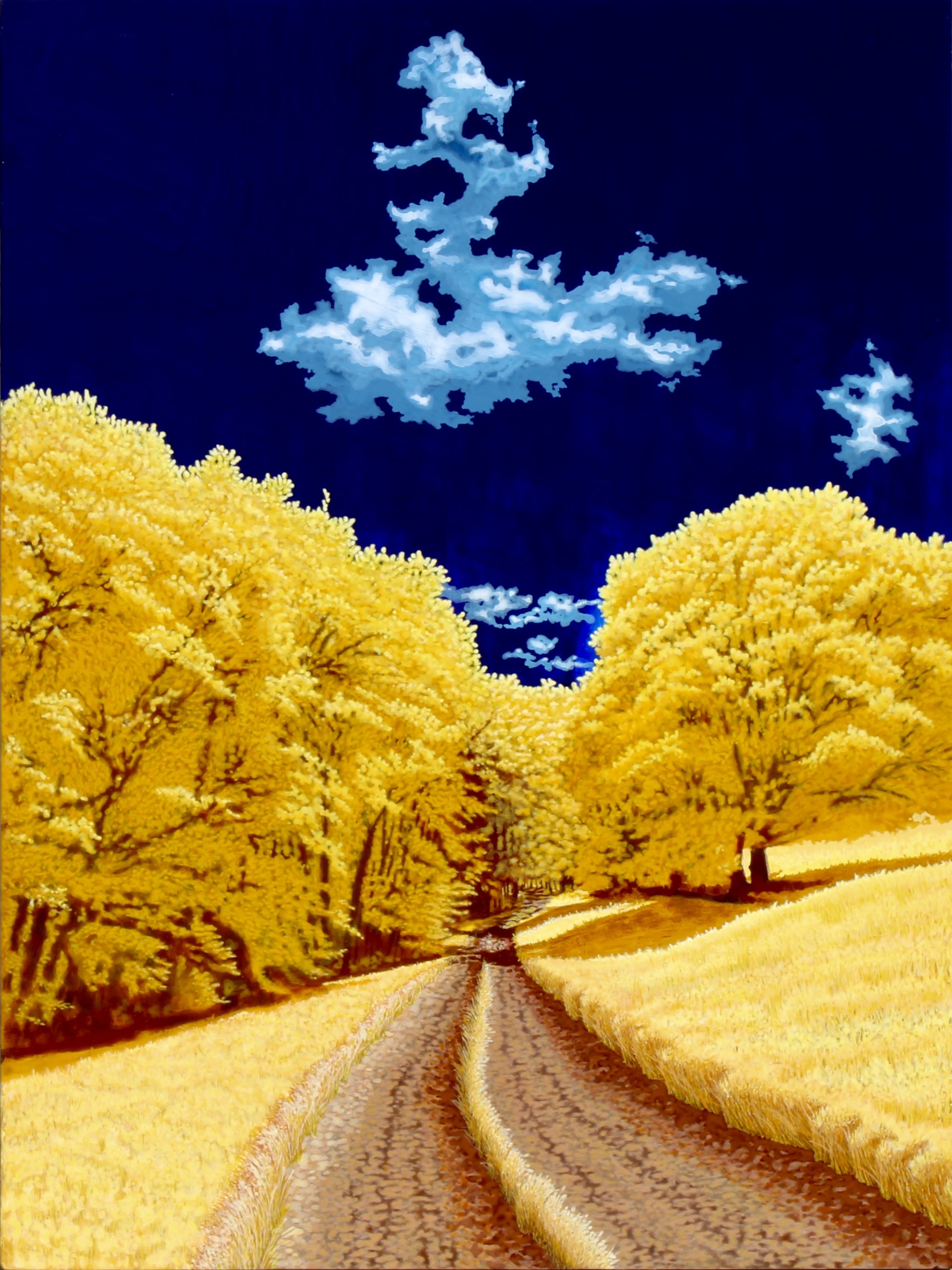
It turns out that being a mere mortal isn’t so bad, after all. In “A Walk in the Woods,” an exhibit of the artist’s landscape paintings from the past two years opening Sept. 20 at Lexington’s New Editions Gallery, Sweet’s triumphant comeback from multiple health scares at the age of 73 will be on full display. His resilience is manifest, as is his ability to adapt to adversity that might have sent some other artists into abrupt retirement. And if the means and methods of these new brushwork paintings are less sui generis than the more stylized woodblock-like frescoes that preceded them, they are, if anything, richer and stranger, more translucent and detailed, more vibrantly colorful and subtly abstract. They’re the mouthwatering work of an artist who found the road ahead closed but took a detour and kept on going, finding a new gear and arriving at his original destination not diminished but refreshed.
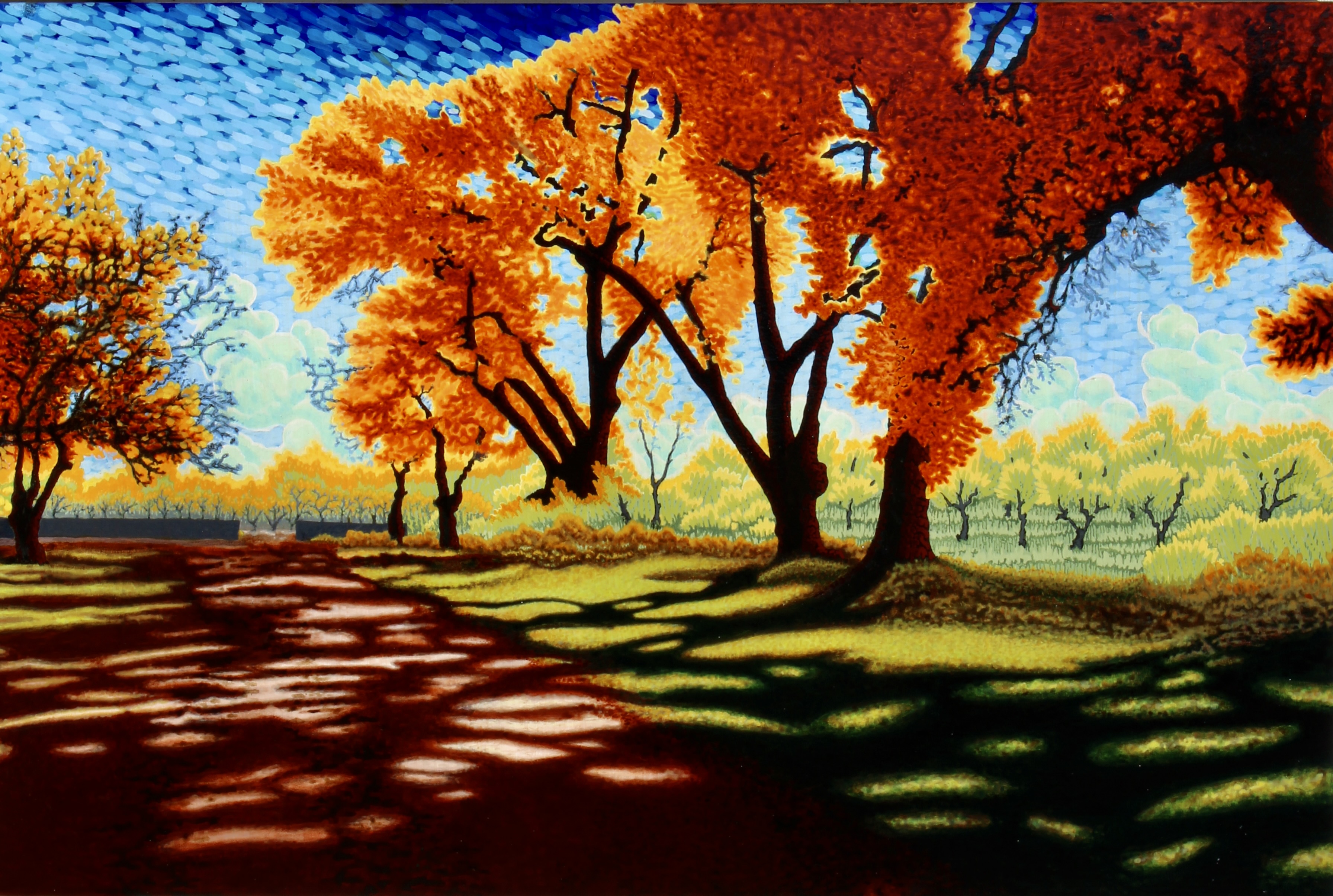
In a series of paintings of cottonwood trees inspired by photographs by his friend Peter Weiss in New Mexico (where Sweet has visited frequently to drink in the Santa Fe art scene over the past 40 years), the autumn leaves fairly thrum with rusty earth tones against a cobalt sky. In one of the two images, “San Luceros Cottonwoods,” the brilliance of the leaves and sky manages to be upstaged by the deep shadows that cloak most of the ground, as if the artist is keenly aware, even on a fine fall day, of the coming of night. That skewed mirroring effect is present, too, in several Kentucky scenes based on photographs by Sweet’s Lexington friend David Allen Fitts.
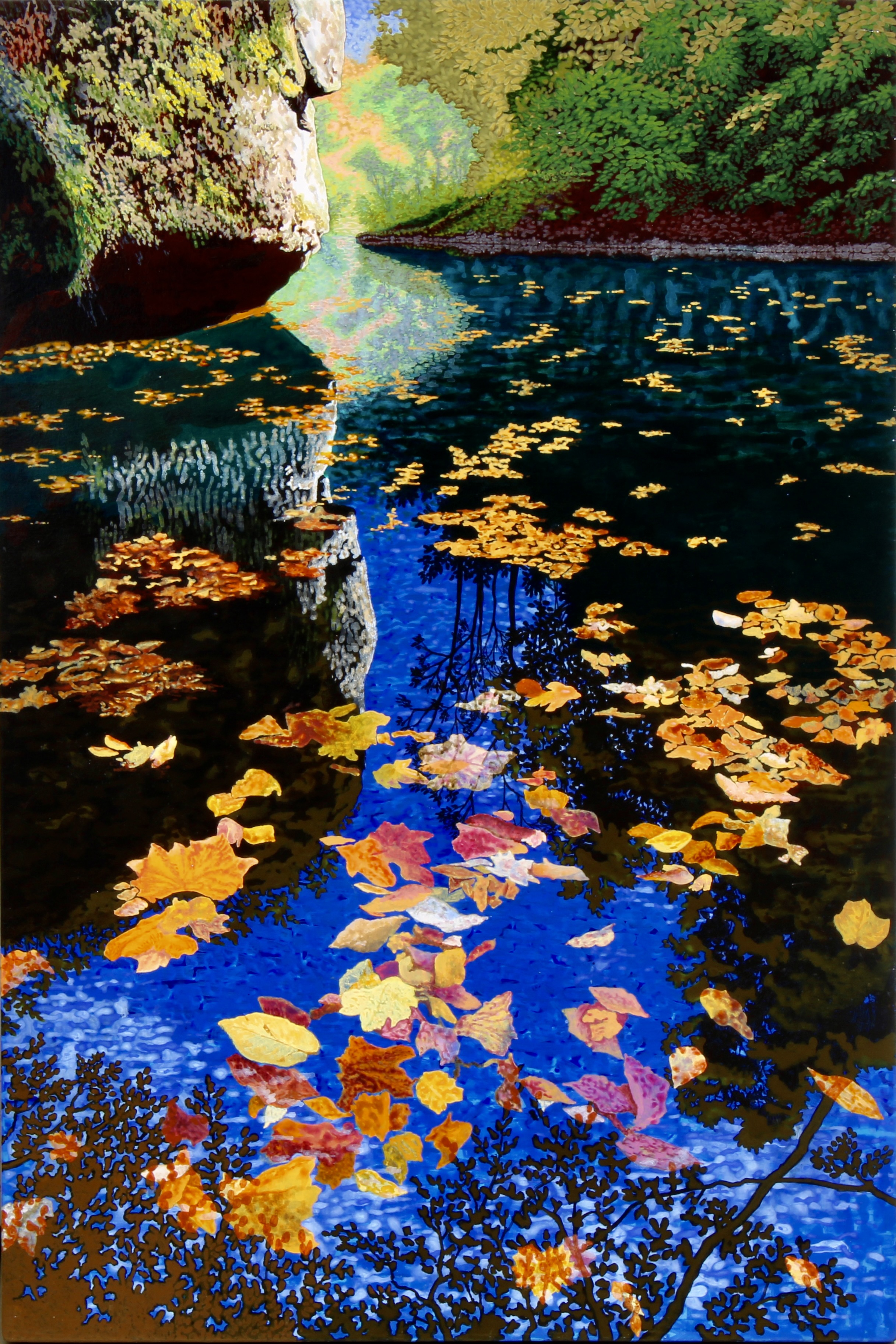
In “Hickman Creek,” “Swift Creek Camp” and “Autumn on the Red” (above), Sweet, fundamentally representational but always in search of opportunities for abstraction, explores the distorted optics of reflections in bodies of water. In the show’s masterpiece, “Autumn on the Red,” the artist delivers a tour de force that conjures a world above the water’s surface and, most compellingly, what’s floating on that surface, what’s reflected in it and even hints of what’s beneath it, all in the same image. Monet would be proud, or maybe jealous, as would M.C. Escher, as would Hiroshige and Hokusai. They would all relate to the prevailing atmosphere, which is clear-eyed yet alert to peripheral vision. The effect is contemplative, daydreamy, a bit wistful, a bit somber — the perspective of an artist at once looking hard at this world and catching glimpses of the next.
“I think Lynn straddles the line between abstraction and representation,” says his friend of several decades, the Louisville-based artist Rodney Hatfield, aka Art Snake. “He’ll do a representational painting and within it, as with those reflections, he creates a little abstract painting. He’s so meticulous, but more and more, he’s taking it beyond that, into capturing a mood, and it’s stunning.”
Those early stirrings
Sweet’s first glimmerings of a life in art came in elementary school in Detroit, where he filled the margins of his notebooks (and perhaps a textbook or two) with drawings of that city’s leading product, cars. His father, an evangelical Christian who moved the family to Wilmore in 1962, when Sweet was 11, wanted him to be a preacher but never discouraged him from pursuing art. As a boy in Kentucky, Sweet loved riding and racing bicycles, a pastime that led naturally to a lifelong love of motorcycles. (He still rides a BMW R1200S motorcycle regularly, often retracing a 130-mile circular route from Lexington to Stamping Ground and Williamstown, back to Cynthiana and home again on Newtown Pike, taking careful note of what he calls “the giant green slalom of Kentucky.” “I like knowing what’s coming over the hill,” he says. “I’m taking it all in, and it’s so beautiful that I’m thinking: that color combination, that change in depth of field — can I use this somehow?”)
Sweet’s first job was at an auto body shop, where he helped mix paints. He attended the University of Kentucky without earning a degree, ending up working at the school’s Department of Art and Visual Studies, where he was a facilities manager, supervising and teaching in the woodworking shop for four decades. For many years he was primarily a designer and maker of neo-modern furniture, often showing his work in UK faculty exhibitions even though, as he’s careful to point out, he was never officially on the faculty. In about 2007, under the influence of the Texas artist Marcia Myers (whose post-Rothko abstract canvases he studied frequently in the galleries of Santa Fe), Sweet delved into non-objective painting, borrowing some of Myers’s compositional techniques and researching her methods and materials, which included mixing marble dust, earth pigments and oxides with acrylic paint medium as a binder. The resulting color palette was intense and earthy, the paint viscous and thick as cake batter. Sweet’s leap to the Wilton piping bags to extrude dabs and ropes of paint onto wood panels, one color at a time, was his aha! moment, but his quantum leap forward came about a decade ago when he received a commission to produce a set of fresco paintings for the University of Kentucky Hospital lobby. Instead of continuing to work in non- objective mode, he decided to apply his new technique to landscape paintings depicting the great green slalom of Kentucky.
“That,” he says, “was the turning point.”
And suddenly, in his fourth decade as a working artist, Lynn Sweet had found his mature style. Despite the delays and detours imposed on him by health-related setbacks over the past five years, he now knows what he’s about and the work that’s before him in the coming years. (He’s “95%” recovered from Guillain-Barré Syndrome, he says, and is now physically stronger than ever, having added lifting weights to his 35-year swimming regimen.) His friends expect him to attack the remainder of his career with gusto.
“He’s the most determined person I’ve ever known,” says Rainey, who watched Sweet recover from Guillain-Barré with the iron will of an Olympic athlete, going to work out at the gym at Cardinal Hill Hospital even when he wasn’t scheduled to be there for physical therapy. “Whatever goes wrong and knocks him down, he’s always going to rally.”
And the mere mortal always has his eyes on what’s coming over the hill.
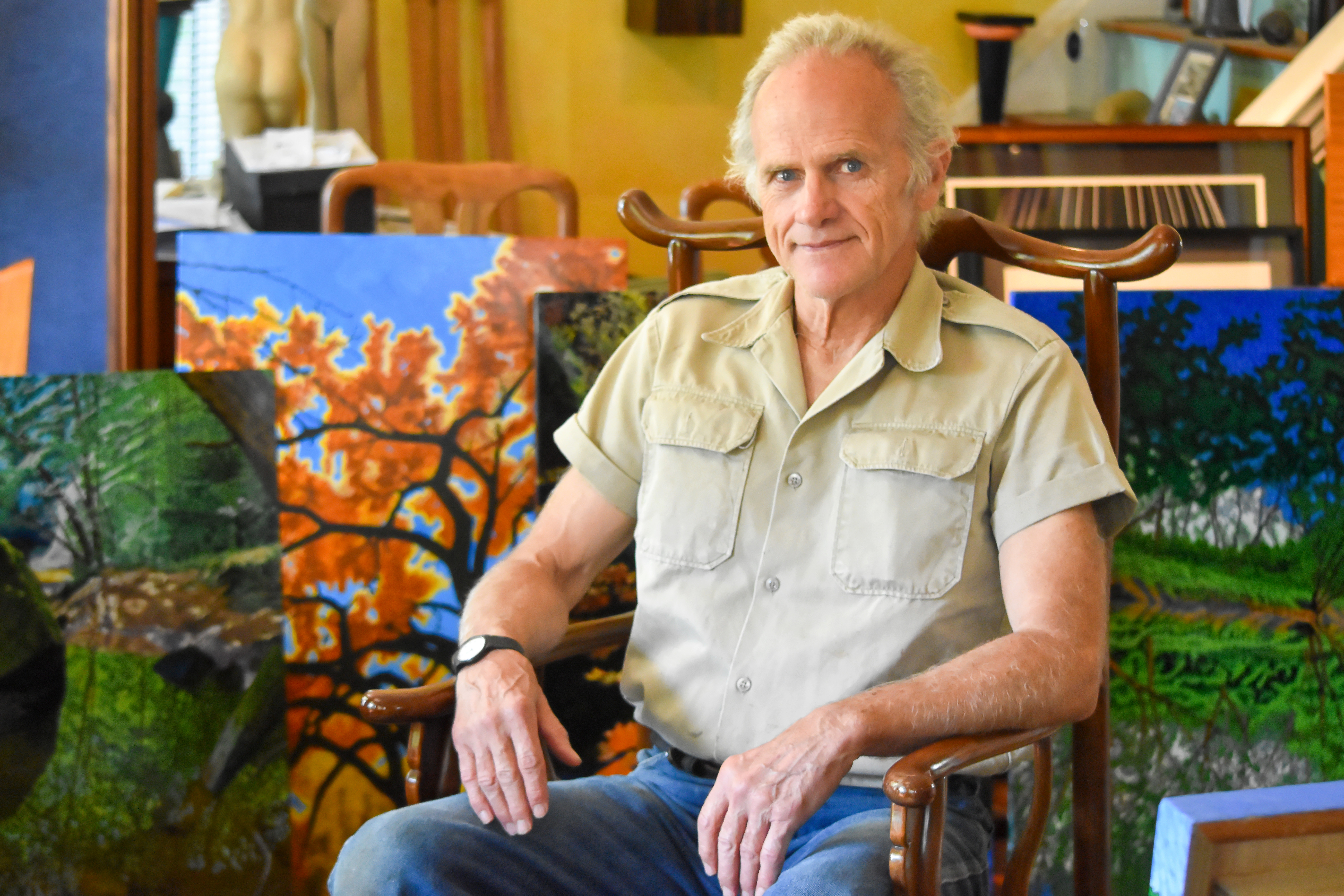
"A Walk in the Woods,” an exhibit of the artist’s landscape paintings from the past two years is showing from Sept. 20 through Nov. 1 at Lexington’s New Editions Gallery,