

Tom Martin talks with Dr. Ellen Furlong about her work to understand what our dogs understand about us, and what they need us to understand about them. Dr. Furlong is a canine cognition researcher at Transylvania University in Lexington, Kentucky. A transcript, edited for clarity in print form, is below.
“People sometimes say that dogs have a sixth sense about a person, but really what they're doing is they're picking up on the body language that that person is giving off and that we might miss because we're paying attention to what people are saying rather than the kinds of things that they're telling us with their bodies.” — Ellen Furlong
Dogs and Humans: A Mutual Admiration Society
A Q&A with dog cognition researcher, Dr. Ellen Furlong

“Olive,” Dr. Furlong's Beagle-Heeler (Photo by Ellen Furlong)
By Tom Martin
Tom: What is it about dogs and humans? Many non-human species share space and affection with us, but especially dogs. What do we know about them? What do they know about us? You can get some answers to these and other questions about these wonderful companions when Ellen Furlong hosts a discussion at Second Story Gallery in downtown Lexington on Sept. 24. I'll have more details about that at the end of this conversation that I'm about to have with Dr. Furlong, an associate professor in psychology at Transylvania University, where she teaches courses on dog cognition and behavior.
As a postdoctoral fellow at Yale University, she studied dogs as well as rhesus monkeys. She recently authored the Audible Great Courses book, Decoding Dogs: Inside the Canine Mind, as well as the textbook, Learning and Behavior.
Ellen Furlong, thanks for joining us.
Ellen: Thanks for having me. I'm always happy to talk about dogs.
Tom: Well, first tell us about yours.
Ellen: I call her a chaos beagle. She's a heeler-beagle mix, and she's three years old. Her name is Olive, and she is wild and crazy. She's a lot of fun.
Tom: Beagles are that, aren't they? I'm going to skip ahead to a question I was going to ask later on, but when you bring up beagles, it reminds me of beagles I've known, which seem to have a sense of humor. Is that me imposing a human trait on a dog, or is there something to that?
Ellen: You know, it's so hard not to impose our human traits on dogs and think about them in sort of an anthropomorphic way. I don't know right off of any research that anybody has done about sense of humor in dogs, but, you know, just anecdotally, I think you're right. I think that sometimes they get a kick out of things. I'm not entirely sure. It would be really interesting to see what the research says about that.
Tom: Some of the finest individuals I've ever known in my life happen to be dogs.
Ellen: Yeah. Me too.
Tom: First, I'd like to clarify what exactly we're talking about when we focus on cognition. How do you define cognition?
Ellen: Yeah, so cognition involves a lot of things that take place in our heads. I think one way to talk about cognition is just to give some examples of what it is. So, things like memory and learning and attention and perception all kind of fall underneath that umbrella of cognition. Thinking, reasoning and all these kinds of invisible mental processes that you can't see taking place all sort of count as cognition. So, “mental computation,” you can kind of think about it that way. But it involves a lot of different kinds of aspects of behavior, social behavior, social reasoning, language, our ability to speak, ability to do math, in addition to kind of basic taking information in from the outside world and processing it internally. All of that counts as cognition.
Tom: In researching and studying dogs, what have you discovered about cognitive intelligence in dogs?
Ellen: I've done lots of different kinds of projects over the years. My dissertation work was with, actually, orangutans and chimpanzees, looking at the evolution of cooperation and competition. But more recently, I'm really interested in dog training myths. So, I think there's tons. If you just google dog training, you're going to come up with tons of information. And some of it is good and some of it is terrible. And your kind of average person who doesn't have a PhD studying dog cognition may have a really hard time pulling apart the good advice from the bad advice. And sometimes maybe there's good advice out there, but we don't know that it's backed by research.
The research that we're doing in my lab right now is actually testing what might be dog training myths. One of them is looking at self-control. So, when Olive was little, we went for a run. She was about a year and a half old, maybe. We went for a run, and she got really excited about a car doing a U-turn right in front of us and bolted after it and broke my hand. And I talked to a friend of mine who's a local trainer and she said, “Oh, Olive needs to work on self-control.” If you train self-control in one domain, it will generalize to other areas. So, if you teach her a really good down-stay in the face of distractions, then she won't chase a car, right? Then she will generalize it to other kinds of things, not knocking grandma over when she comes to the door, not chasing cars, not counter-surfing; all of these things that we don't like dogs to do.
Tom: Are dogs self-aware?
Ellen: Well, I think it depends on what you mean by self-aware and how we measure it. So, there's a couple of different kinds of classic self-awareness tasks out there. One is the famous mark test, where you put a spot on the face of an animal or of a child, and then you put them in front of a mirror, and you see how they interact with that mirror. Do they look at themselves? Do they try and remove the spot while they're looking at themselves? And if so, then they pass the test, and we say that they have self-consciousness. But maybe that test isn't so great.
If you look at some species like elephants, for example, they have terrible eyesight, so they're not going to do very well on the task unless you make an elephant-sized mirror, which is really hard, as you can imagine. And gorillas are going to fail the task because making eye contact is very rude. And so, they find it uncomfortable even to make eye contact with themselves in the mirror. So, this might not be a really great task because of some species' specific kind of task demands.
In another task that people have used to study self-awareness, they put a mat on the ground and there's a toy attached to the underside of the mat. And the dog is standing on the mat. The dog's body weight is preventing the toy from coming up from under the mat, and so the dog has to step o9 the mat. So, they have to recognize that it is their own self that is causing the toy to be inaccessible. So, those tasks dogs do quite well on, but they don't do very well on the mirror task.
Tom: That's really interesting. I've read that dogs can be better at understanding human cues and at distinguishing between different kinds of things or of objects than we give them credit for.
Ellen: Yes, they're very good. And I think a lot of people are often quite surprised to hear that dogs are often better at some of these tasks than species that are very closely related to us, like chimpanzees. So, I think the thing that's really interesting here is that dogs really pay very, very close attention to our behavior and our body language. For dogs, body language is key. That's one of the major ways that they communicate with each other. And so, they pay extremely close attention to human body language and sometimes understand more about us than we might think.
People sometimes say that dogs have a sixth sense about a person, but really what they're doing is they're picking up on the body language that that person is giving off that we might miss because we're paying attention to what people are saying rather than the kinds of things that they're telling us with their bodies.
Tom: What are some examples of cognitive intelligence and cognitive behavior in dogs?
Ellen: Basically, anytime we talk about any kind of decision-making task that you might give a dog counts as a cognitive task. One that we're doing in my lab right now that's a self-control task is called the cylinder task, and I think it's a really easy one to explain. We have a clear cylinder so the dogs can see that there's a treat that's being placed inside. But in order to get to the treat, the dog has to detour around to the side, to the openings of the cylinder. The openings are on the side rather than in the front. So, the dog actually has to move away from the food that's right in front of them to go to the side to get the food. And this is a pretty challenging task for dogs because that moving away from something they want is an example of cognition. They have to problem solve. “How do I get this food? I have to think about it and solve this problem.”
Another one that we're doing in the lab that's a kind of classic cognitive task is called the A-not-B error. This was first designed to be done in kids to study object permanence. So, do they know that an object continues to exist even when they can't see it? It turns out that kids were failing this task even though they had object permanence because it requires some impulse control.
So, in this task, kids or dogs see a toy or a treat hidden in one of two buckets. We're going to call that the A bucket. And they find the toy or the treat there several times. Our dogs find it three times in the A bucket. And then they watch as the experimenter places the toy or the treat in bucket A and then picks up the toy or treat and moves it over to bucket B. So, they see that entire sequence. And the question is will they continue to search at bucket A, or will they detour over to bucket B where they have seen the treat move?
A surprising number of dogs and babies keep going to A — “A is where I found the treat last time. It's where the treat keeps appearing and [I] don't track it as it moves over to B.” So, those are some sort of classic examples of cognitive tasks.
Tom: One of the most fascinating things to witness is the work of a border collie with sheep or an Australian shepherd with cattle. They seem to be making split-second decisions as they're doing their thing and moving the herd toward a place or a corral. Is that what's going on?
Ellen: Yeah. So, there's actually a lot that goes on with working dogs while they're working. This takes us to sort of a classic nature versus nurture debate that you've probably encountered many times. And the question really is how much of their working is built in, is genetic, is instinct and how much of it is learned, nurture? There are definitely pieces of both happening when dogs are working. They definitely come in with instinct.
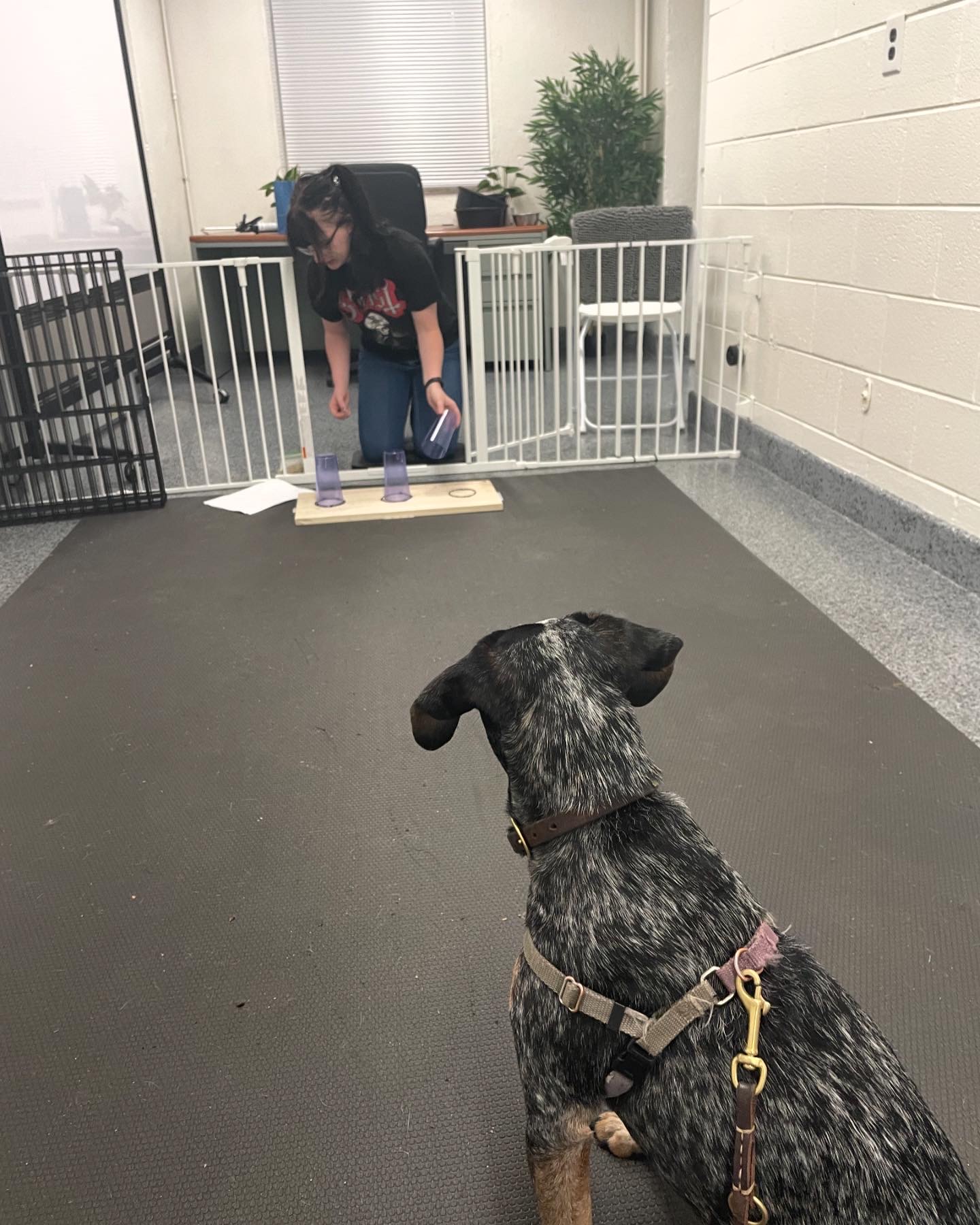
Olive in Dr. Furlong's dog cognition lab
Olive did an instinct test once to see if she had any. She's half-heeler. She might want to herd. She did an instinct test, and Olive has no instinct for herding. So, a lot of those dogs are going to have that instinct built in. They're going to know how to do some of those things, kind of automatically. But they do have to adjust to the behavior of the animals that they're herding or that they're working. And that's where that kind of learning takes place, where the kind of decision-making and thinking about the future — “where might that animal move in just a minute, how can I anticipate that and cut them off?” — this really takes place.
There's also a lot of learning and coordination with people. So, you'll hear a lot of times the shepherds will either give verbal cues like come by, or they'll use whistles that mean different kinds of things. And so, the dog has to learn which way the handler thinks they should go when they're dealing with the animals or what the handler wants them to do. And so, there's a lot of coordination there.
People ask me, what's the smartest dog breed? And that's a really impossible question to answer. But usually, if you look at those lists, the border collies and the Australian shepherds are going to be way at the top. And I think the reason is that they're very trainable. So, they're very eager. Part of their instincts are that they're eager to learn from and work with humans.
And so, I think those lists actually are measuring things like trainability because you have other dogs that are way at the bottom of the list like an Afghan hound is usually at the very bottom of the list, but they work much more independently. So, they're not quite so eager to learn what humans want them to do.
Tom: Do we know why humans and dogs have this strong affinity for each other? What's behind that mutual attraction?
Ellen: This is a great question and actually one that we don't have a great answer to. There are a couple theories out there about why humans and dogs have this very special relationship. If we get in our time machine and go way back in the history of humans and dogs, you know, humans and wolves were living together about 400,000 years ago. So, we know that humans and the predecessors of dogs were living near each other but not interacting in any kind of a social way. So,we're going back in our time machine. We're looking back 400,000 years or so in the early history of dogs and humans, and this is way before there were dogs. This is humans and wolves living together but separate lives. And they continued to do that for hundreds of thousands of years. But something changed and we're not entirely sure what that something is, either somewhere around 30,000 years ago or somewhere around 10,000 years ago. And that's when dogs started to come on the scene.
There are a couple different explanations about why humans and wolves suddenly formed this alliance and what may have changed to lead to this. If humans and wolves became friends earlier, so 30,000 years ago, then probably we did so for the mutual hunting benefits. Wolves are excellent trackers, but they hunt animals that have weapons like antlers, whereas humans have weapons ourselves, and we can hunt from a distance. So, it could be that humans and wolves sort of had an uneasy truce for a little while where we were following the wolves as they were tracking, and then we would actually do the kill, and then we would share our spoils with the wolves. We would take some and leave some for the wolves.
If humans and dogs came on the scene a little bit later, so closer to about 10,000 years ago, that was about when agriculture came about and when humans started to have permanent settlements. And so, the idea there is that probably what happened is that wolves realized that humans had trash piles, and then dogs would have evolved as scavengers. And then over time, we kind of recognized each other's benefits, and the dogs that were more tolerant of people tended to have better success passing on their genes. And humans recognize the benefits of dogs, right? Pest control, for example, around a garbage heap or hunting.
Over time, dogs have fulfilled lots of different needs for humans, from cooperative hunting to herding. One of my favorite stories about a working dog was I was bringing students back from a trip to Europe, and we were in line at customs in Chicago, and a little Spaniel came up to a girl, maybe a five-year-old, in line ahead of me and alerted that she had contraband in her bag, and it was a banana. So, we have fruit-detecting dogs looking for contraband in the airports. They serve many, many different functions for us now.
Tom: Well, bringing it around to the latter part of that 10,000-year span, and here we are with Fluffy sitting on the sofa, and just hanging out and being a good pal. Are we right to think that dogs actually understand human emotions and words?
Ellen: Well, so those are two different things, so I'll take them separately.
Tom: Sure.
Ellen: Let's go with words first. We know that dogs are incredibly good at picking up human words. So, if you've ever had to spell out W-A-L-K rather than saying “walk” around the dog, then you probably have experienced this. My dog before Olive was Cleo. She was an Australian shepherd mix. And I was telling a friend about a book I was reading by John le Carré, and Cleo picked up “car” from that and wanted to go for a ride.
So, they definitely can pick up words. Your average dog knows, I believe about 30 words that they've picked up from just living with and around humans. And that process usually happens by some kind of associative learning. So, they hear you say “walk,” and then you pick up the leash, and then you take them out for a walk, and that's exciting. Or they hear you say the word “dinner” and all of a sudden, here's this delicious kibble in a bowl, and they're very excited about that. So, that's associative learning, and that's not a particularly complicated learning process. You can get associative learning in just about any species that you look at.
But dogs also do something that's a lot more complicated than that. There are not a lot of dogs that do this, but some seem to learn by something that's called “fast mapping," which is where they kind of learn by exclusion. So, you've got a dog who's got five toys in front of them, and they know the names for four of the toys, and then you give a new name that they've never heard before: “elephant,” right? They've never heard any toy called “elephant” before. And so, they're looking at the five toys, four of them they know are not called “elephant,” and so that fifth one must be “elephant.” And so, they can learn very quickly through that method, which is very similar to how toddlers learn words.
So, dogs can do something complicated with words. They can also learn categories like ball, and then figure out that even a new ball that they've never seen before might be called a ball. They can learn things like bigger or smaller — bring me the big ball or the big rope, bring me the small rope — and they can differentiate between those.
People are currently doing research on this topic to see what is the extent of dog vocabulary, and to what extent are they able to use information that they're getting from humans?
Research is also ongoing about what they understand about human emotion. There's a couple alternative explanations here. One is when you have a person who's crying and the dog comes over and appears to give them comfort, it could be because the dog is actually seeking comfort that the person is upset. So, it could be “you're crying and now I'm sad and I need a hug.” And so, they might go up to their person and solicit attention because they're looking for that comfort themselves. Or it could be you're sad and I'm coming over to give you support. And behaviorally, in dogs, those two look kind of similar. So, people are working on teasing those apart as we speak.
Tom: We've had relatives spending the summer with us while they renovate a place to live here in Lexington. And every morning, their dog Jack comes bounding down the stairs seemingly filled with joy for the new day and just so happy to see everybody. And you know, it would be easy to just say, well, he's really telling you he needs to go out to pee, but there does really seem to be something more to it. Am I right about that, or are we just reading too much into the behavior?
Ellen: Yeah, I think many people would not disagree that dogs have some emotions, for sure. I think you would be hard-pressed to find anybody who does dog research who says dogs can't feel joy, right? We definitely think that they can feel happiness. They can feel sadness. There are several basic emotions that you can see that look like they're pretty common across humans, and then many of those emotions also seem to be emotions that many other species can feel too.
So, looking at their behavior and looking at things like their brain chemistry and the ways that their brains are wired we're pretty confident that Jack could be feeling happiness when he's starting a brand-new exciting day. But there are some emotions that we're pretty sure dogs don't feel. These are kind of second order emotions, things like shame and guilt.
People often say that their dog looks guilty when they come home and the dog has done something they oughtn't. But research suggests that that probably is not actually guilt. They're probably learning associatively that, you know, when there is a mess on the floor and there is you, then they get in trouble, right? And so, they're not actually showing you guilt. What they're showing is submission and appeasement, trying to keep you from getting mad that there is a mess on the floor. So, they probably feel a lot of those primary emotions but probably not those sort of higher order emotions.
Tom: Why do dogs seem to cock their heads when we talk to them?
Ellen: We don't really know. You know, some of it is that they can just be perceptual about how their ears are shaped and how they're bringing in information. Some people suggest that maybe it's processing the information. So, it's not sensory so much as it is they're just kind of thinking about what you're saying and the tone of voice that you're using and that kind of thing. So, just like you might also tilt your head and kind of look off into the distance as you're answering a question that somebody asks, they might be doing the same kind of thing as they're kind of trying to process what it is that you're saying to them. So, we're not entirely sure.
Tom: Here's another one for you. We often see a car pass by with a dog hanging their head out the window in the breeze. My father always used to say, "Oh, that dog is getting the news." And of course, dogs do have these amazing olfactory senses, but was Dad right about that?
Ellen: Dogs have an absolutely amazing sense of smell. Their sense of smell is somewhere between 10 and 100,000 times better than our own. I think the best way to contextualize that is that a human might detect a teaspoon of sugar in a cup of coffee, but a dog could detect that teaspoon of sugar in enough water to fill two Olympic-sized swimming pools. So, they have an incredible sense of smell, and they get a ton of information from that.
There was a recent paper out that I absolutely love assigning to my students about how dogs' olfactory processes happen in the brain. And if you look at the brain of humans, we've got this little bitty thing. It's called the olfactory bulb, where sense of smell is processed, but it's just little bitty. It's not super impressive. But when you look at the dog brain, the olfactory bulb is huge, but then it sends projections all over the brain. And interestingly, it sends a ton of projections to the occipital cortex, which is where vision is processed.
And so, it seems like the authors interpret this paper as saying that dogs are, in some ways, synesthetes. Synesthetes have a blending of the senses. They might see color when they look at numbers — maybe three is red and five is blue. And so, they're able to do really impressive calculations and really impressive things much faster than people who are not synesthetes. And it could be that dogs are, in some ways, synesthetes where they are actually seeing odor. The sensory world of the dog is just so dramatically different from the sensory world that we have that it's kind of hard to conceptualize. But I really love thinking about that idea of dogs kind of seeing smells. It's just fascinating to me.
Tom: What would you say are the most important things that you would want us to think about, to consider when we're thinking about bringing a dog into our homes and our lives?
Ellen: A couple things. The first two major things that I would like people to think about. One is finding a really good trainer. And a really good trainer could look like lots of different things, but good trainers are going to be “R+” or positive reinforcement trainers. They're going to use the best science in training and really focus on telling the dogs what they're doing right rather than telling the dogs what they're doing wrong.
Good research suggests that animals and humans actually learn much better by being reinforced for the good things that they're doing and having those bad things that they're doing ignored rather than using punishment to extinguish those bad things that people don't like. So, finding a good positive reinforcement trainer is a really great first step. Even seeing that trainer before the dog even comes home to help you figure out how to set that pup up for success before they come in the door can be really helpful.
A second thing is to make sure that you're thinking about the dog's mental needs. So here, another term for this is thinking about enrichment for your dog, and enrichment can look like lots of different things. Many people think that this is about going for walks, but Olive, my dog, is afraid of garbage trucks. So, on garbage day, walks don't happen. But that doesn't mean that she has to just sit at home being bored all day, right? We can do other kinds of things. We do a lot of scent games. She has food puzzles. We do training games. There's lots of other ways that you can enrich your dog mentally than just taking them for a walk.
And even when you're taking dogs for a walk, a lot of times we think it's really about exercise, right? It's like a march. We're going to keep going, but the dog wants to stop and sniff things because as you mentioned before, that's how they're getting the news. So, letting your dog make choices and stop and smell and smell something as long as they need to is really important. I take my own exercise walks on my own without Olive, but I bring her with me when it's for her, right? So, making sure that you are considering your dog's needs, allowing your dog to be a dog. And many good dog trainers can help you think about enrichment as well.
Tom: That's Dr. Ellen Furlong. She will host a conversation about canine companionship, 6:30 to 7:30 on the evening of Tuesday, Sept. 24, at Second Story Gallery. That's at 522 West Short Street in downtown Lexington. And you can learn more at secondstory.art. Thanks, Ellen.
Ellen: Thank you so much. This was lots of fun.
Be sure to visit Sarah Hoskins' preview of the “Dogs & Cats” exhibition opening on Sept. 20 at Headley-Whitney Museum, 4435 Old Frankfort Pike, Lexington.

Art Snake "Smithers Goes Tippin" 2024. “Dogs & Cats” exhibition at Headley Whitney Museum