

RALPHIE TO THE RESCUE
Behind the scenes at The Lexington Theatre Company’s musical, “A Christmas Story”
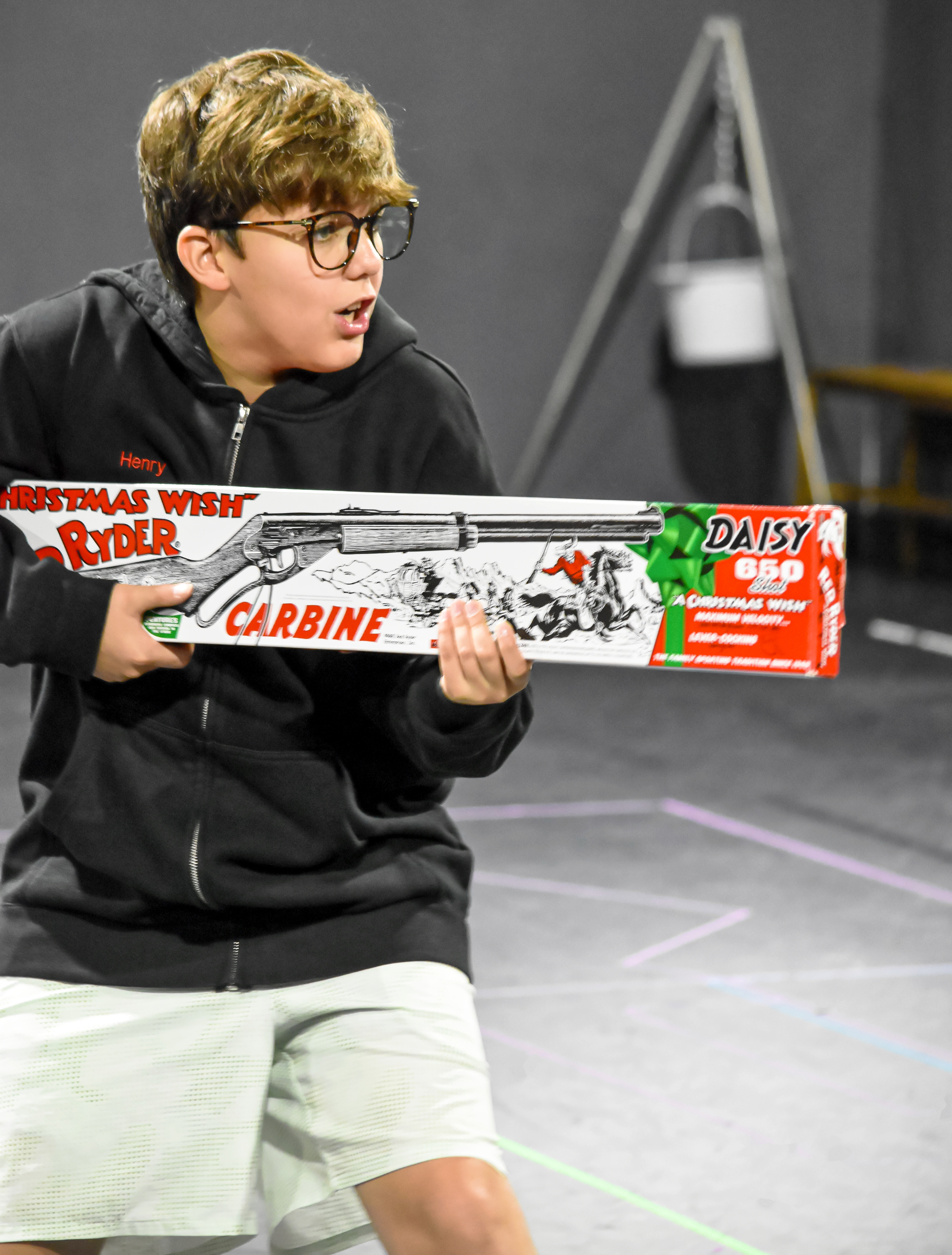
Henry Walter as Ralphie in The Lexington Theatre Company production of “A Christmas Story”
By Kevin Nance
Contributing Writer, Photographer
[Editor's note: When we're in the audience of a live theater production, we focus on what is happening before our eyes. We don't see the beehive of activity taking place backstage. Becoming aware of all of the unseen activity that is critical to a successful and entertaining theatrical stage production can be an eye-opener that adds depth and dimension to the experience. We asked contributing writer Kevin Nance to give us a “behind-the-scenes” perspective on a production currently in rehearsals.]
It takes a lot of legwork to put on a musical: actors, directors, musicians, choreographers, designers, stage managers working at top speed, mostly behind the scenes. Sets, costumes, props. Lots and lots of props — including, in the case of The Lexington Theatre Company’s upcoming production of “A Christmas Story” — a lamp in the shape of an actual leg.
A Christmas Story opens Nov. 21 at the Lexington Opera House. The musical is based on the classic holiday movie set in 1940 about a boy named Ralphie who pines for a Red Ryder BB gun for Christmas, only to be warned repeatedly that “you’ll shoot your eye out!” In one scene alone, the sheer number of Depression-era props is downright dizzying. Much of a recent rehearsal at LTC’s headquarters on Alexandria Drive, a morning scene in the musical, is spent with an inventory of props rivaling a real kitchen. There are glasses, plates, bowls, silverware. Containers of milk and orange juice. An old-fashioned coffee percolator and coffee cups. A pot of oatmeal that Ralphie (played by SCAPA student Henry Walter), his younger brother Randy (Luke Krohmer) and their contest-loving dad, known as the Old Man (Brance Cornelius), have for breakfast onstage.
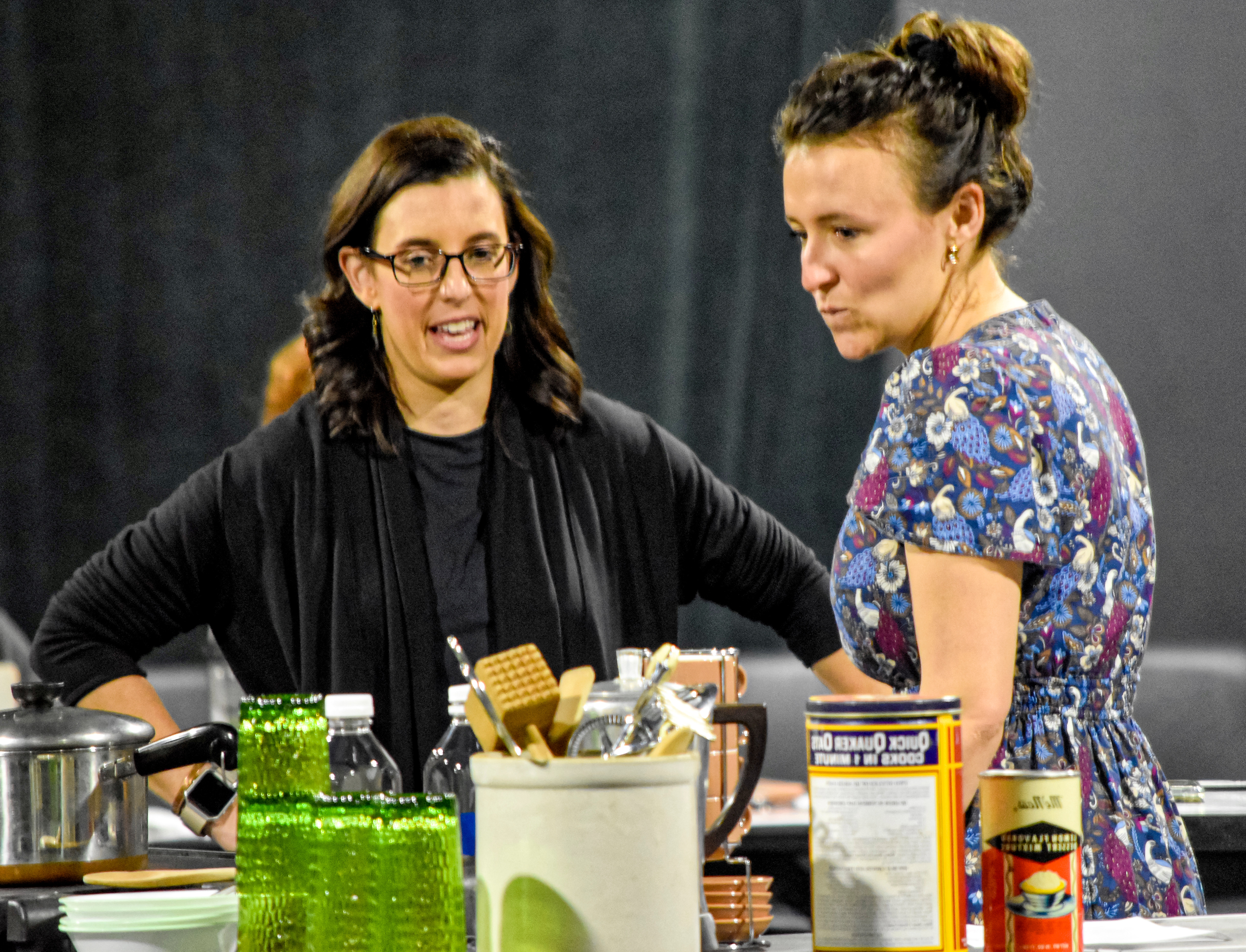
“A Christmas Story” director Lyndy Smith and actress Lee Harrington rehearse amid myriad vintage kitchen props
The character of Mother is played by Lee Harrington, who must serve the meal while singing, delivering lines and working with all those props in a specific sequence laid out by director Lyndy Franklin Smith: (1) start making the oatmeal, (2) set out bowls, (3) finish making the oatmeal, (4) add brown sugar and “stir, stir,” (5) pour the boys' juice. “And then when all is said and done,” Smith says, consulting her notes, “she will pour herself a cup of coffee and then sit down.”
“I don’t mean to be annoying,” Harrington says at one point, “but I don’t really eat gluten or dairy.”
“You don’t have to eat a thing,” Smith says soothingly. “They do make really good gluten- and dairy-free things now, but you don’t have to eat a thing.”
They run the sequence repeatedly, Harrington a flurry of the frantic energy of a multitasking mom getting her family fed and out the door on a busy school day. “Ralphie! Randy! Get ready for school,” she calls up a flight of imaginary stairs. “Oh! Goodness gracious! It’s a blizzard already and December’s just begun.”
The breakfast things are far from the only props in this musical adaptation, which features music and lyrics by Benj Pasek and Justin Paul and a book by Joseph Robinette. (The 1983 film version, starring Peter Billingsley, Darren McGavin and Melinda Dillon, was based on the nostalgic, semi-autobiographical book In God We Trust: All Others Pay Cash [1966] by the humor writer and radio host Jean Shepherd, who appears in the musical as the narrator. Shepherd is played in the musical by Wayne Bryan, a Broadway veteran and the recently retired producing artistic director of Music Theatre Wichita, where LTC’s Lyndy and Jeromy Smith got much of the experience that launched their professional theater careers in New York and later inspired them to co-found The Lex.)
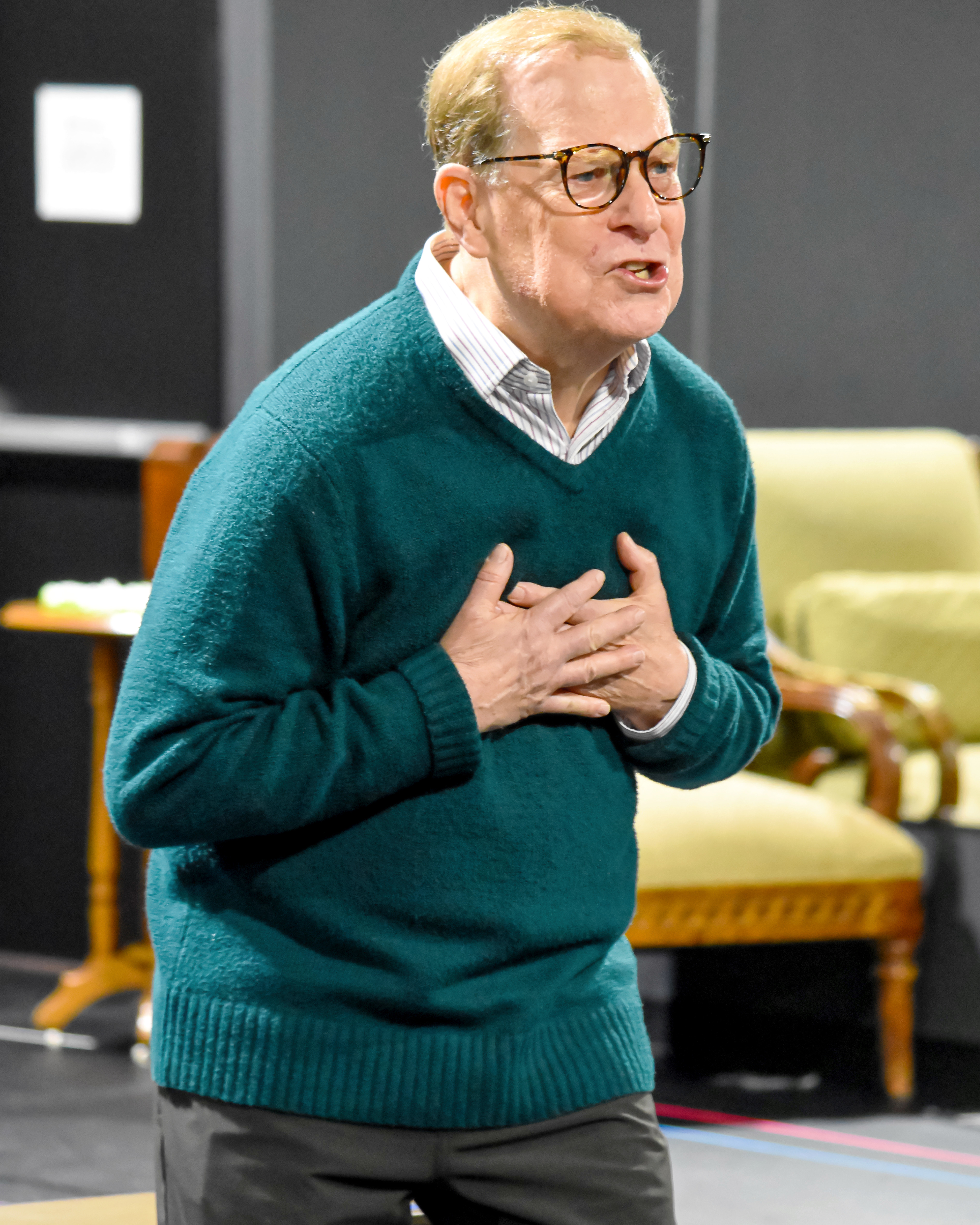
Wayne Bryan as Jean Shepherd
“A Christmas Story” wouldn’t be “A Christmas Story,” after all, without the Red Ryder Carbine Action BB gun, or what the Old Man calls “A Major Award” from a newspaper contest — a gaudy lamp with a tasseled shade and a base molded like a woman’s shapely leg sheathed in
a fishnet stocking. (At a towering 42 inches, the leg lamp in the musical is even bigger than in the film, which the awestruck Old Man — to his wife’s horror — proudly displays in the window.) There’s the freezing schoolyard flagpole, to which Ralphie’s friend’s tongue gets stuck. And there’s the bunny suit, which the wretched Ralphie is forced to wear until his dad lets him take
it off.
The musical, which had a brief Broadway run in 2012 and has since had several national tours (none of which stopped at the Opera House, because of the production’s large size), features all these familiar elements from the film but spins some of them into new, often fantastical directions. In one scene, for example, the leg lamp comes to life in an eye-popping tap-dance sequence choreographed by Lyndy Smith. The number features half a dozen female performers wearing costumes inspired by the lampshade. They are joined by a dapper version of the Old Man.
“The musical has all of those moments from the movie,” says Jeromy Smith, the company’s director, “but it also has a lot of heart, great tunes and all of that musical theater showmanship and pizzazz that people want.”
Costume Design
In The Lex costume shop, designer Elizabeth Payne and a crew of assistants are hard at work on the costumes from the “Major Award” production number, with yards of golden fabric being prepared to adorn the lampshades. On a nearby bulletin board, dozens of research drawings and sketches for the scores of costumes in the show point the way toward “how the scenes will look in the end, give or take,” Payne says with a laugh. “It’s a big show.”
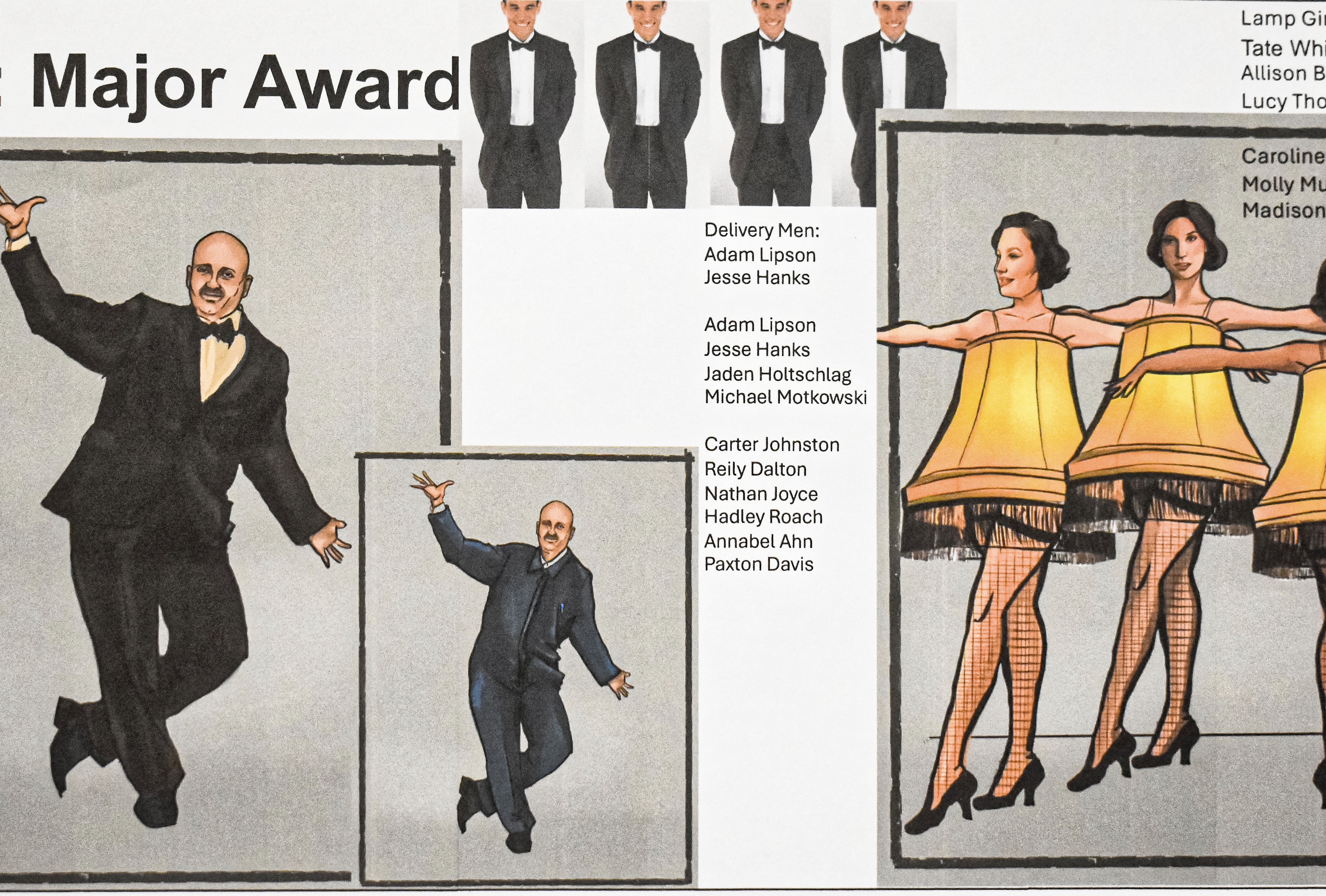
“A Major Award” costume design
One of biggest challenges for Payne and her team is “Ralphie to the Rescue,” a six-minute musical sequence in which Ralphie begins in his classroom, imagining what he’ll do with his longed-for Red Ryder BB gun. Suddenly dressed like the heroic cowboy Red Ryder himself, Ralphie gets into a fistfight with a bank robber dressed as a dastardly, mustache-wearing villain from the silent-movie era; in Smith’s vision, the fight with the villain foreshadows the tussle Ralphie will later have with his real-life nemesis, Scut Farkas (Elijah Burton). At another point, he finds himself in an Old West saloon with cancan girls, while elsewhere Ralphie’s teacher Miss Shields (Cecilia Snow), transforms into a torch singer at a speakeasy, complete with flapper girls and gangsters.

Costume designer Elizabeth Payne
“The musical lets Ralphie step into the fantasies in a way that he didn’t in the film,” Payne says. "We’re trying to make those moments come alive.”
Scenic Design
If the costumes in “A Christmas Story” the musical go beyond the film, the scenic design goes even further. “It’s a big show that comes with all the visual expectations of the movie, which people absolutely love,” scenic designer Kyle Dixon says in an interview over Zoom. “On the other hand, we don’t want to copy the movie. We want to do our own thing with it, too, so you have to walk the line there — giving the people what they want, but also making it our own.”
Dixon started with the interior of the family home, which needed to look “lived-in” rather than run-down, he says. “The house has to do a lot of things,” he adds. “There has to be a staircase. There has to be a back door, so that the neighbor’s dog can come in and steal the turkey. Then there’s how to get it on and off the stage, which is all about mechanics and how all the pieces fit together. You start with that and build out from there.”
The set also had to convey the house’s modest size. “We wanted a sense not of clutter but the feeling that there wasn’t enough space in the house for all the things in it,” Lyndy Smith says. “In the kitchen scene, for example, there are so many items that have to fit on the countertop that we have to imagine that the house isn’t super large. There are coats hung over the bannister, socks on the floor, toys strewn about. We wanted it to feel intimate, lived-in, loved on.”
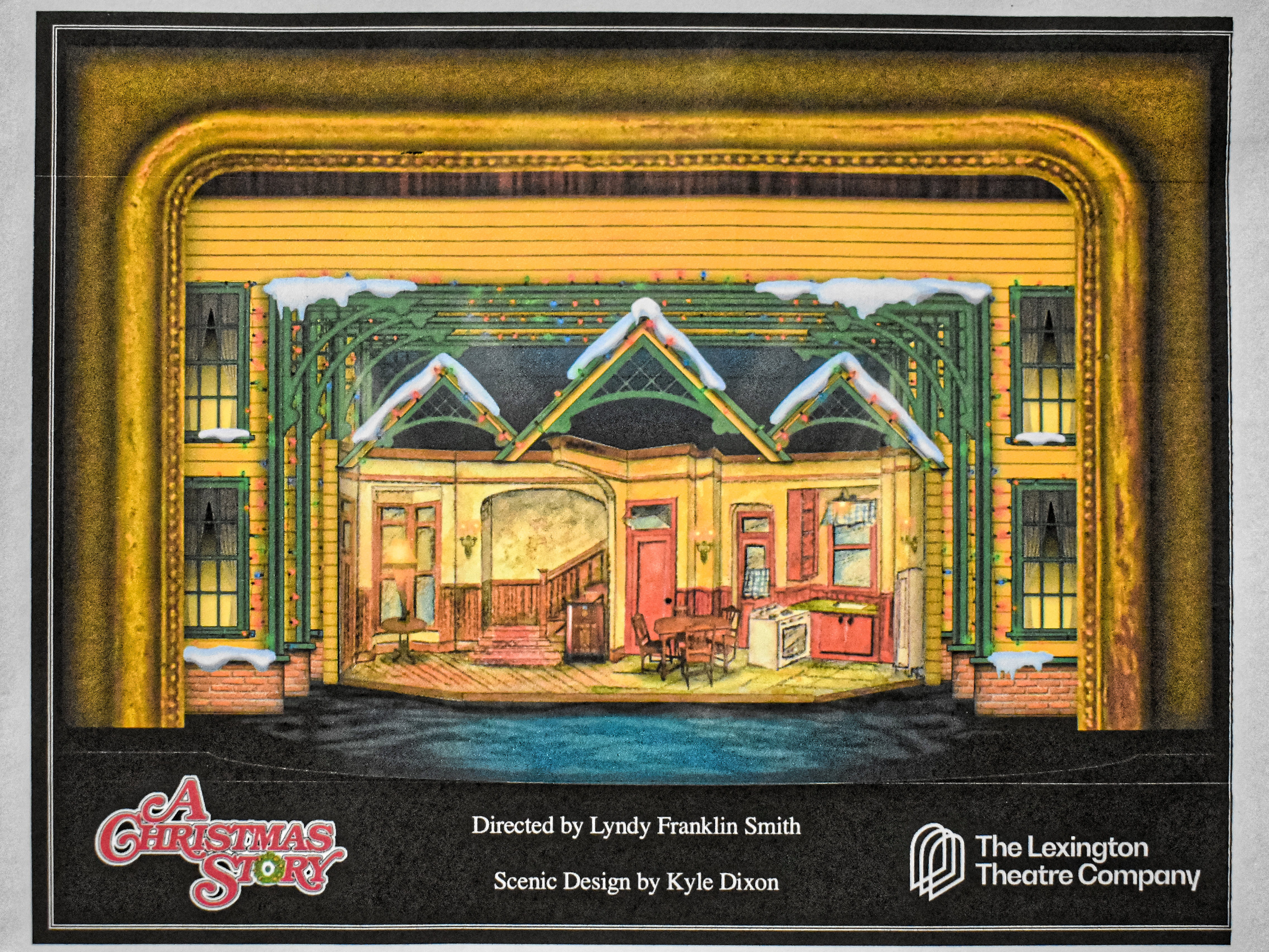
There’s also a transparent scrim and a series of backdrops inspired by vintage Christmas cards from the 1930s and early ’40s. “Instantly when you look at that artwork, it’s nostalgic,” Dixon says. “To me, the holidays are a time of nostalgia, anyway. That was the jumping off point for all the colors, some of the style. Color-wise, certainly, the whole thing should feel like a warm fuzzy hug.”
The sets, scrim, drapes and backdrops get their ultimate workout in “Ralphie to the Rescue,” which Smith has conceived as an outgrowth of Jean Shepherd’s narrated memory. After starting in the classroom, “The scrim bleeds through, so it feels like we’re fading back in time,” she says. “The drops fly in and peel back, revealing three different locations in the sequence before taking us right back into the classroom. It’s incredibly cinematic, and it’s been fun to play on this canvas Kyle made for me. It’s all coming together really beautifully.”
The Lexington Theatre Company production of A Christmas Story opens at the Lexington Opera House on Thursday, Nov. 21 at 7:30 pm. For information, click here.
