

“It prompted Stuart and I to start talking about how various artists have addressed the complexities of family life — the good, the bad, the dirty and everything in between — and it became pretty clear that this could be a fruitful premise for an exhibition." — Leah Kolb
All in the Family: A joint exhibition

Rachael Banks “Untitled (The Meadow),” 2019. Archival pigment print, 15x20 inches. Courtesy of the artist.
A Q&A with University of Kentucky Art Museum Director Stuart Horodner (SH) and 2nd Story owner Leah Kolb (LK)
By UK students Alexander Croghan (Anthropology and Art History) and Annie Vicary (Studio Art)
The title of the joint exhibition is “All in the Family,” inspired by the 1970s CBS sitcom. What led you to choose this title and what is the connection between the television show and the exhibition? Are the themes cohesive?
SH: Leah found a photo of graffiti in a house and we thought that was a lively phrase. It started us thinking about a possible exhibition. At some point “All in the Family ” came up, and I like the reference to the legendary television show, which was significant in my childhood. The fact that this sitcom addressed issues like bigotry, the Vietnam War, and feminism made us think that an exhibition with that title could similarly tackle contemporary realities. And everyone can appreciate the challenges of relatives negotiating their differences of opinion!
LK: We were driving from Lexington to Madison, Wisconsin to have Thanksgiving with my family. Whenever we're on a road trip and Stuart is driving, I have a bit of an addiction to looking at houses for sale on Redfin as we pass through each city. One of the homes listed (maybe in Gary, Indiana?) included images of the living room, which was absolutely filthy: stained walls, dirty carpet, broken blinds, etc. It didn't look terribly inhabitable. One of the decor items left behind was a vinyl decal on the wall that said "Family is everything." The contrast between that wholesome message in vinyl and the actual state of the house was jarring. It prompted Stuart and I to start talking about how various artists have addressed the complexities of family life — the good, the bad, the dirty, and everything in-between — and it became pretty clear that this could be a fruitful premise for an exhibition. We had originally used "Family Is Everything" as the working title, but then Stuart suggested referencing the television sitcom "All in the Family," which seemed like a more perfect fit, given the reasons he mentions above.
How did being in a relationship influence your curation process? Did it differ from working with other curators who you aren't as close with?
SH: I have collaborated with a few curators over the years, all friends whose work I really respect. So in that sense, it was the same with Leah. The subject of this exhibition made particular sense given our relationship and I think examining “family life” while building ours together was particularly meaningful.
LK: I found the process to be more fun and generative. Stuart and I tend to have different reference points and, to a certain extent, different artists who are on our respective radars. However, we have a very similar sensibility when it comes to what we find compelling. Sharing and talking through ideas with Stuart was a reminder of how collaborating, in general, can make for a more robust exhibition ... and how fulfilling it is to be in a relationship with someone who speaks a similar language, professionally and creatively.
In what ways did your relationship make the process easier or harder? How did it impact the decisions you made, whether through compromise, outreach or contacting artists?
LK: Easier in some ways; harder in others. I work from home quite a bit, so when I'm in "work mode," I have to intentionally create that mental space in order to be productive. When Stuart and I would start talking about the exhibition at home, casually (like over coffee or something), it wasn't always clear to me that we were making actual decisions as opposed to brainstorming and informally thinking through ideas. Since we talk about art all the time in our day-to-day conversations anyway, and because I kind of need to know when to switch over into my official curator role, I think it would have been easier for me to go somewhere else, outside of the house, when working together on the show.
SH: That’s interesting. I think I am always in a curator mode, so us talking at home about the artists was a blur I was comfortable with. I thought we were making exhibition decisions right along with, “Do you want eggs or granola for breakfast?”
Is there a reason you both chose to work on and show this exhibition right now?
SH: How couples navigate their personal and professional realities is interesting to us. For example, I have spent a fair amount of time watching how Taylor Swift and Travis Kelce are handling this. Leah and I have been living together for two years with Paco, our canine “son.” I am a serious dog dad now. And we are aware of my already established role in the Lexington arts community while Leah is defining her own since moving here.
We also regularly discuss the fact that we want more arts and culture enthusiasts in Lexington. A two-venue exhibition with an accessible but complex theme might help to get viewers out to see both installations while thinking about their own identity as a child, parent, sibling, lover, etc.
Some works in the exhibition at the University of Kentucky Art Museum are drawn from the permanent collection. Can you walk us through the process of selecting these pieces? Were they chosen based on your memory or familiarity with them, or did you conduct specific research to find family-centric works? What guided your choices?
SH: Whenever I’m working on an exhibition that could include works in the museum’s collection, a search is done for various possibilities. What do we have that could fit? Once that list is gathered, options become clear. For example, works made by artists picturing their mothers, like photographs by Rolf Koppel and Guy Mendes. An important decision was to include the incredible Aaron Skolnick drawings of himself and his partner Louis Zoellar Bickett, who was dying at the time. These were a gift from Aaron, and we’ve never exhibited them before.
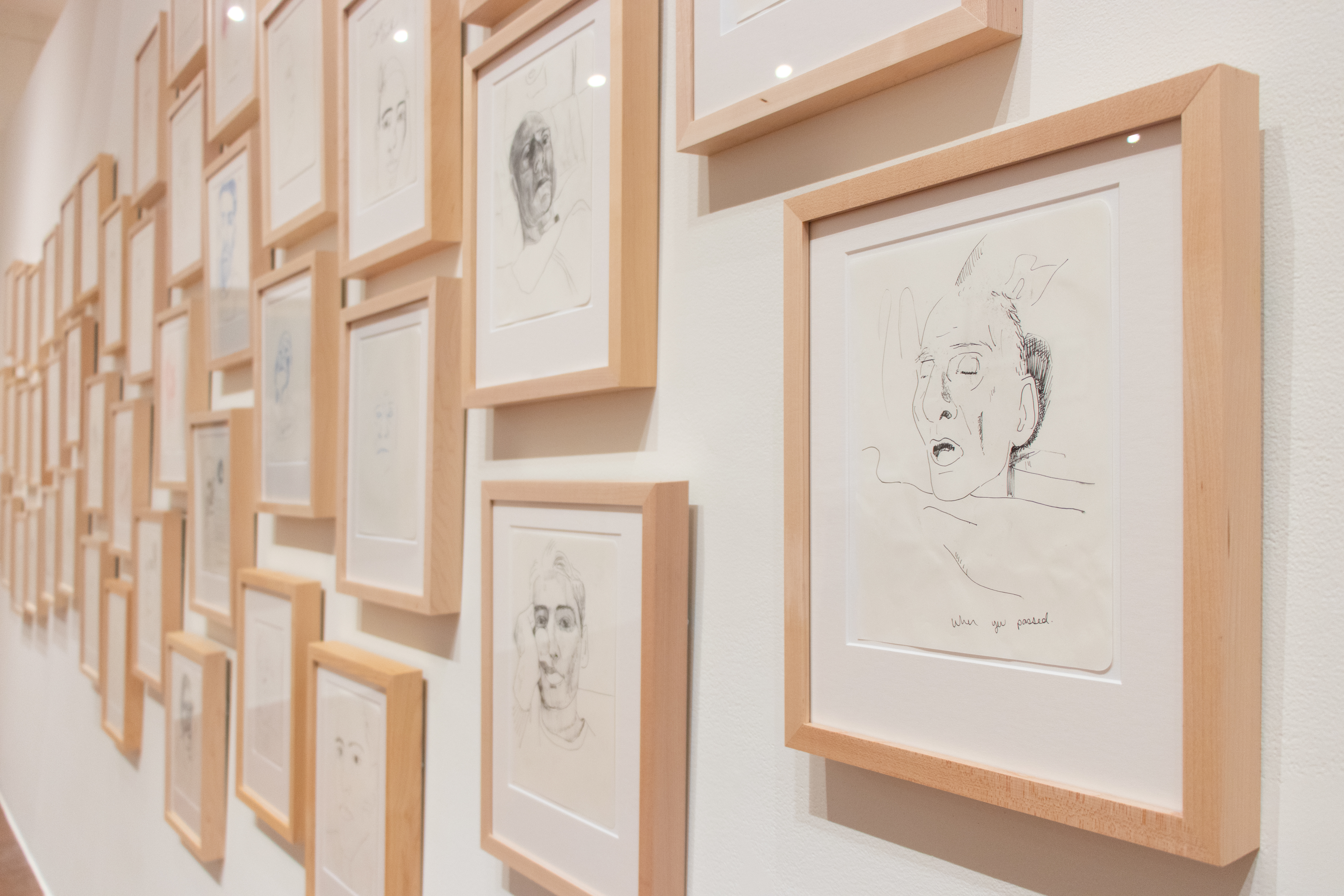
Aaron Michael Skolnick “A Landscape That I Know,” 2016-18. Graphite, color pencil, and ink on paper. Collection of the UK Art Museum.
I knew about photographs by Richard Billingham, Katy Grannan and Marilyn Minter, in the collection of George and Linda Kurz in Cincinnati. They are always very generous in lending us amazing works. Other loans from artists including Judy Linn, Gaela Erwin and Barbara Pollack made great connections with works we’d already decided on. Knowing about artists and collectors is essential in having options to create the checklist that matches your curatorial ideas.
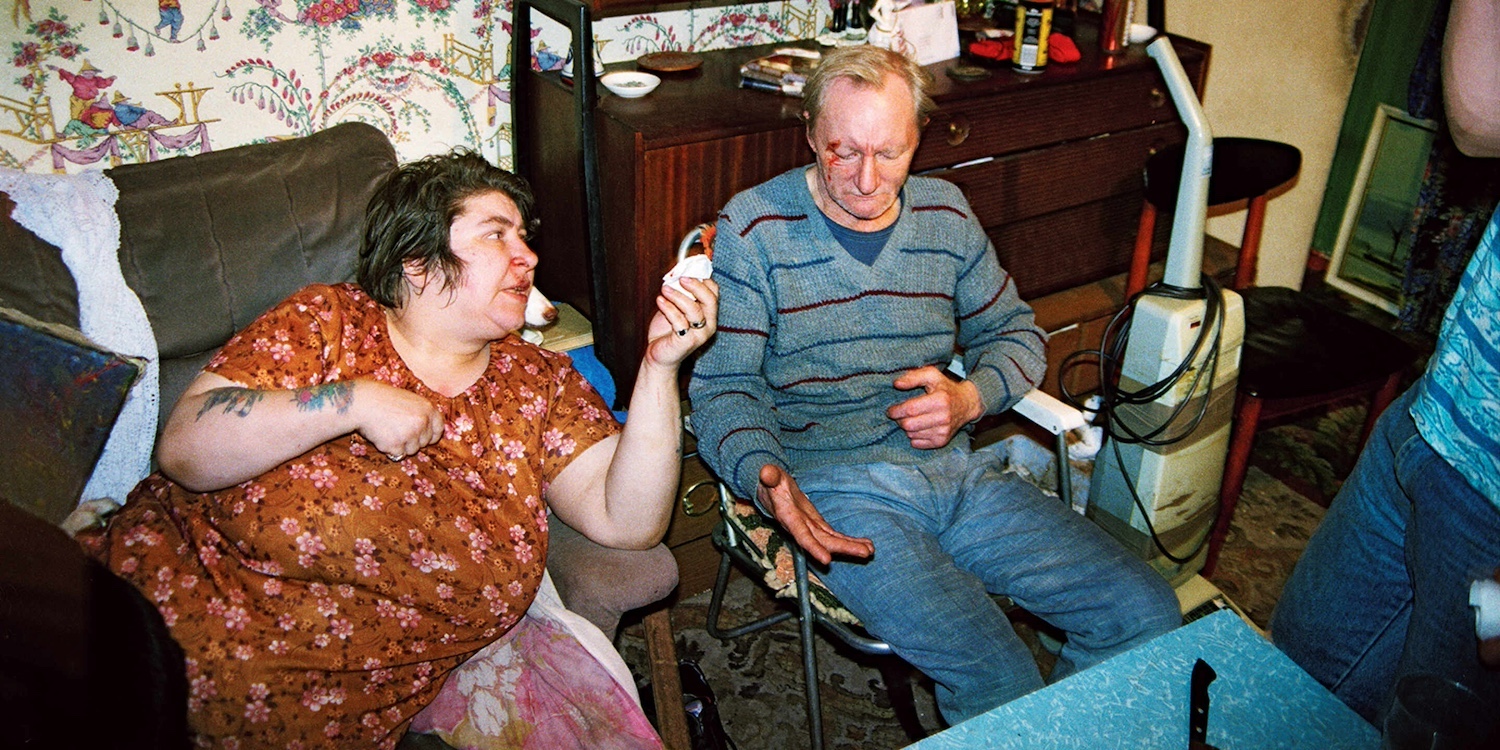
Richard Billingham “Ray's a Laugh (Nosebleed),” 1994. Cibachrome print mounted to aluminum, 41 x 62 inches. Collection of George and Linda Kurz
The layout of Skolnick’s “A Landscape That I Know” deviates from a grid pattern and isn’t entirely chronological. What was the reasoning behind this choice?
SH: We used the strategy that artist Aaron Skolnick used when he installed the drawings in his solo exhibition at Fierman Gallery in NYC in 2019. I think it creates more visual and emotional rhythms than a chronological plan would. The abundance of tenderness and love that comes through the grouping is very powerful.
The exhibition touches on themes of chosen family and death, with particular emphasis on animals and queer identities. Could you elaborate on the relevance of these themes to the overall narrative of the exhibition?
LK: The significance of representing chosen families, particularly among queer-identifying people, is certainly not a new concept within the visual arts, but I think it really hit home for me several years ago when I was working on an exhibition of Rashaad Newsome's vogueing videos. For many LGBTQ+ voguers, ballroom “houses” function as chosen families, providing a support system and mentorship and most importantly, offering acceptance, love and a sense of belonging. When I moved to Lexington two years ago, Stuart introduced me to the inimitable Bob Morgan, whose past and present — in addition to his artwork — is very much wrapped up in similar notions of chosen family and the people who played defining roles in his life, including his "gay father," Henry Faulkner. It seemed obvious to us that Bob’s very real family unit needed to be represented.
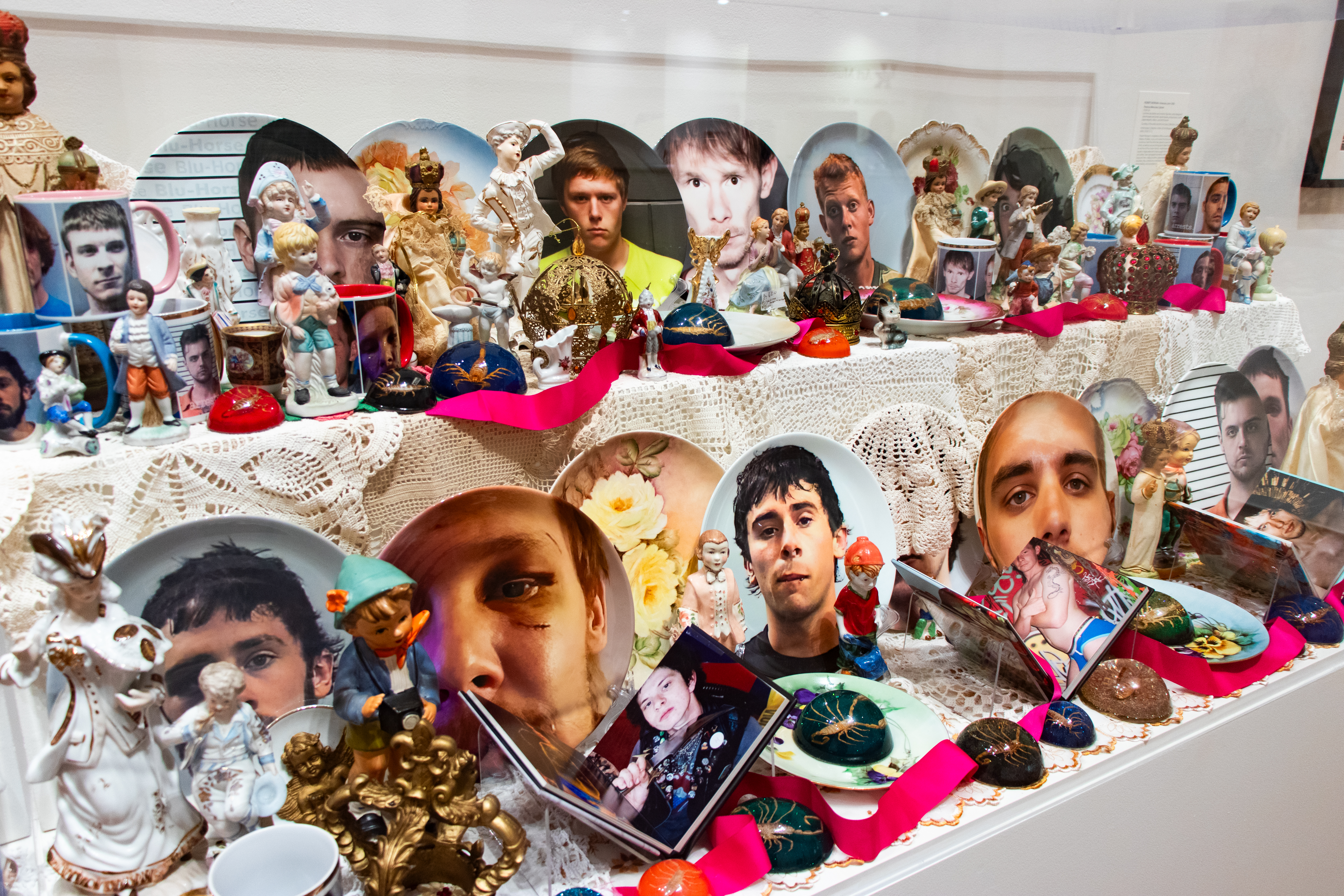
Robert Morgan “Precious Memories Cabinet,” 2018-24. Commercial plaster and ceramic figurines, artist-designed ceramicware and photo ceramicware, antique lace, Lucite paperweights, ribbon, and artist books. Courtesy of the artist, the Jim Gray Collection, and the UK Art Museum.
As for pets, all I can say is although I consciously decided to not procreate, I cannot imagine life without Paco, my four-legged "child," who happens to be a rescue Chihuahua mix. I think maternal — and paternal! — love is an expansive thing and absolutely applies to non-human entities. This has been reinforced over the last couple of years as I've watched Stuart and Paco develop an intense bond and undeniable love for each other.
With that in mind, I’ve invited Dr. Ellen Furlong to give a talk at 2nd Story about canine cognition and the love that develops between dogs and their humans. I particularly enjoy inviting artists, curators, writers, educators, anthropologists and others to give informal lectures in conjunction with our exhibitions. (An Undermain interview with Dr. Furlong will be featured in our Sept. 17 edition.)
SH: Leah summed it up nicely. Any examination of family today would have to look at the subject from multiple points of view and be very inclusive. We’d certainly want the audience to see themselves represented.
The exhibition features a variety of media, despite a strong focus on portraiture. Was the inclusion of portraiture an intentional choice from the outset, or did it evolve as you collected more pieces? For example, how do works like “Maternal Proverb” and “You Transform Everything into a Boat,” which break traditional portrait themes, fit into this framework?
LK: In addition to Rachael Banks' poignant photographs of her family and Richard Billingham's massive family portrait of his troubled parents, I was also really interested in thinking about how the theme of "family" could be represented in ways that deviate from portraiture. In other words, how do artists express familial connection, or disfunction, without figuration? I suppose Camila Galaz's video, "You Transform Everything into a Boat," could be considered quasi-figurative, but it only shows her hands and her father's hands while he teaches her how to tie a sailor's knot. We don't see their faces, and their recorded audio doesn't give the audience much to work with either, as it's simply a narration of how to tie the knots. But the repetition of gestures — the artist's painstaking attempts to mimic her dad's movements — speaks to the deep desire to connect with, learn from and understand one's parental figure(s). In my mind, it's a meditation on the things that "tie" families together.
Camila Galaz “You Transform Everything into a Boat,” 2017. Video (color, sound), 4.07 min. Courtesy of the artist.
Helen Lee's "Maternal Proverb" is decidedly non-figurative: it's a scroll with a Chinese phrase the artist wrote using her own breastmilk. Broadly, it points to the function of language as a carrier of heritage and culture (important aspects of what gets passed down within families). The phrase Lee chose to include on the scroll is a Chinese expression of unity and camaraderie that her mother stated when she was surrounded by her whole family. A direct source of essential nutrients for her own baby, the artist's breastmilk, also became a tool to transcribe and elevate her mother's maternal wisdom into a work of art, thereby symbolically uniting three generations together on a single scroll.
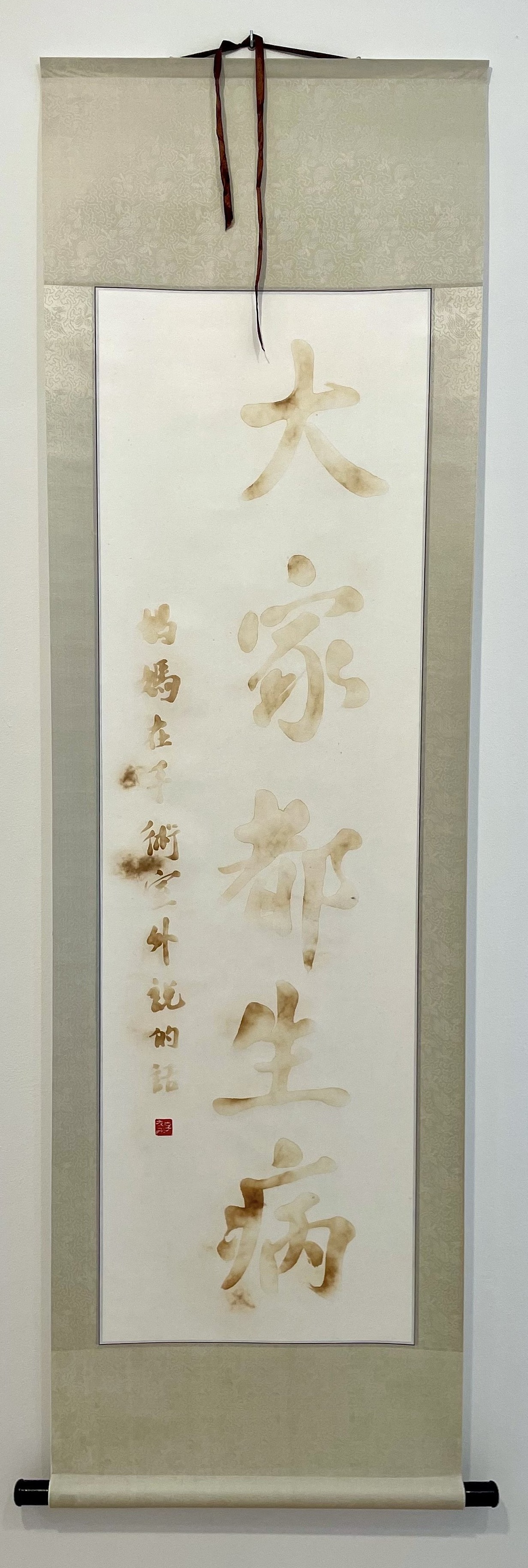
Helen Lee “Maternal Proverb,” 2015. Singed breastmilk on rice paper, 70 x 20 1/2 inches. Courtesy of the artist.
Were the curatorial layouts of the two exhibitions designed to be cohesive with each other, or were they oriented towards the specific art and location of each venue? Bob Morgan, for example, often does installations where he is very hands-on. Do other artists have a say in layouts? Like Rae Goodwin?
SH: They were designed to complement each other and feature different kinds of works. We each had final say about the installations in our respective spaces but offered feedback throughout the process. I knew what Bob Morgan wanted to exhibit at the museum and simply gave him the vitrine to use and left him alone to figure it out. The more he put in the better it looked! Leah suggested Rae Goodwin’s exploration of grandmothers and Rae hasn’t shown this particular work for many years. She was on hand to help with the installation, establishing the heights and angles of the various component parts.
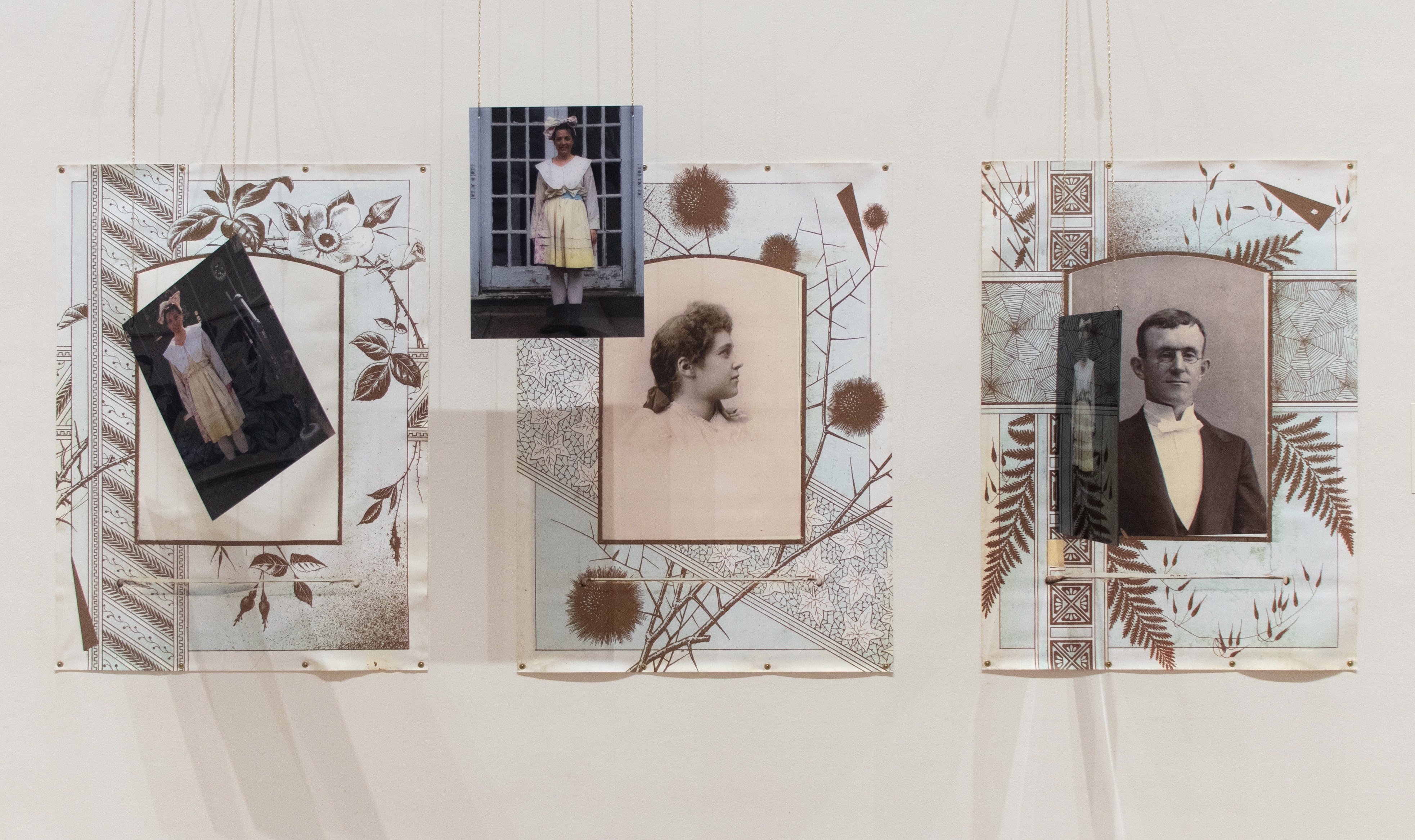
Rae Goodwin, “Trying to Fit In,” 2009. Printed canvas, C-prints on Plexiglas, and hardware. Courtesy of the artist.
One cohesive element we should mention is that both exhibits include groupings of found photographs. Some I already owned, and others we went shopping to find once we established the categories of babies and couples.
LK: The gallery space at 2nd Story is pretty small, so many of the layout decisions for this exhibition were determined by where certain artworks could actually fit, and where specific works (e.g., Helen Lee's delicate scroll) wouldn't be exposed to direct sunlight. Usually, more conceptual considerations are part of the layout process, but sometimes it simply has to be practical.
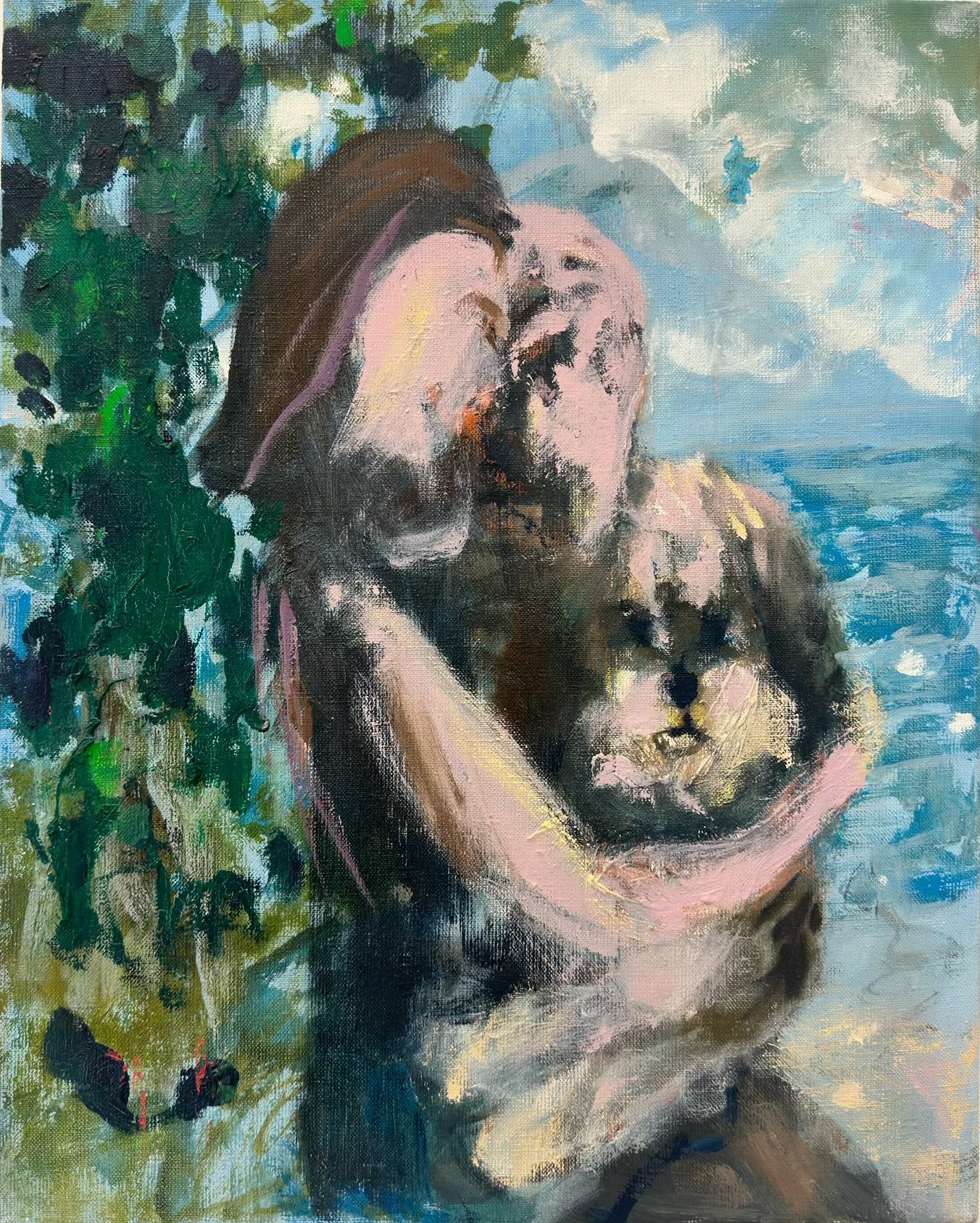
Bill Adams “Benny, Bill, and Alix,” 2023. Oil on canvas, 18x11 inches. Courtesy of the artist.