

"I have always done it just for my pure pleasure. I've given my friends paintings but never got them out in the world.” — Lesa Aker
From Basement Drawer to Light of Day

Lesa Aker — Forty Winks
By Kate Savage
Contributing Interviewer
Kate Savage interviewed Eubank, KY artist Lesa Aker for the Arts Connect “Art Throb” podcast. You can listen and read along below. The interview was edited for Savage's “Today's Interview” feature on WEKU.
Kate: My guest today is Lesa Aker. Lesa is a self-taught artist with current work in the “Dogs and Cats" exhibition at the Headley-Whitney Museum (through Nov. 24) as well as in the “Compare and Contrast” show in the John G. Irvin Gallery at Central Bank in downtown Lexington. Lesa, until fairly recently, you've never shown your work. Is that correct?
Lesa: That's correct. Never 'til this year. I have always done it just for my pure pleasure. I've given my friends paintings but never got them out in the world.
Kate: Well, that's pretty incredible. So you've been painting for a long time. I won't give away your age, but you know, you're kind of up there like me. What have you done with all this work that you've accumulated?
Lesa: Well, I've only done pastels for about four years, and most of them ended up under the bed, the big ones. The smaller ones have their own drawer, and that's where they stayed. I would get them out and look at them sometimes.
Kate: So you really just sort of stashed them away and created them, and it's not been important to you to have other people enjoy them?
Lesa: No, I put them online. People do enjoy them. I've just never tried to make any money because that puts a different take on things, although it is nice.
Kate: Yes, it does have a sort of a commercial aspect to it. But if you're not doing it to make a living, then I'm sure it allows you a lot more freedom in the creative process. Talking about which, you have worked in oils and acrylics, but you've settled on pastels as your medium of choice. What is it that you particularly like about this?
Lesa: I can take a smaller amount of time and get more done. I don't have to clean up anything. I don't have to get out anything. I can just leave it all sitting until I get ready. And if I only have 15 minutes, I can still get down and do something in 15 minutes.
Kate: You say “get down.” Do you have a studio somewhere?
Lesa: In my basement, in the den. I've got a nice little corner with a big huge toolbox that is just crammed full of stuff, and it's a good place to work. It's really nice.
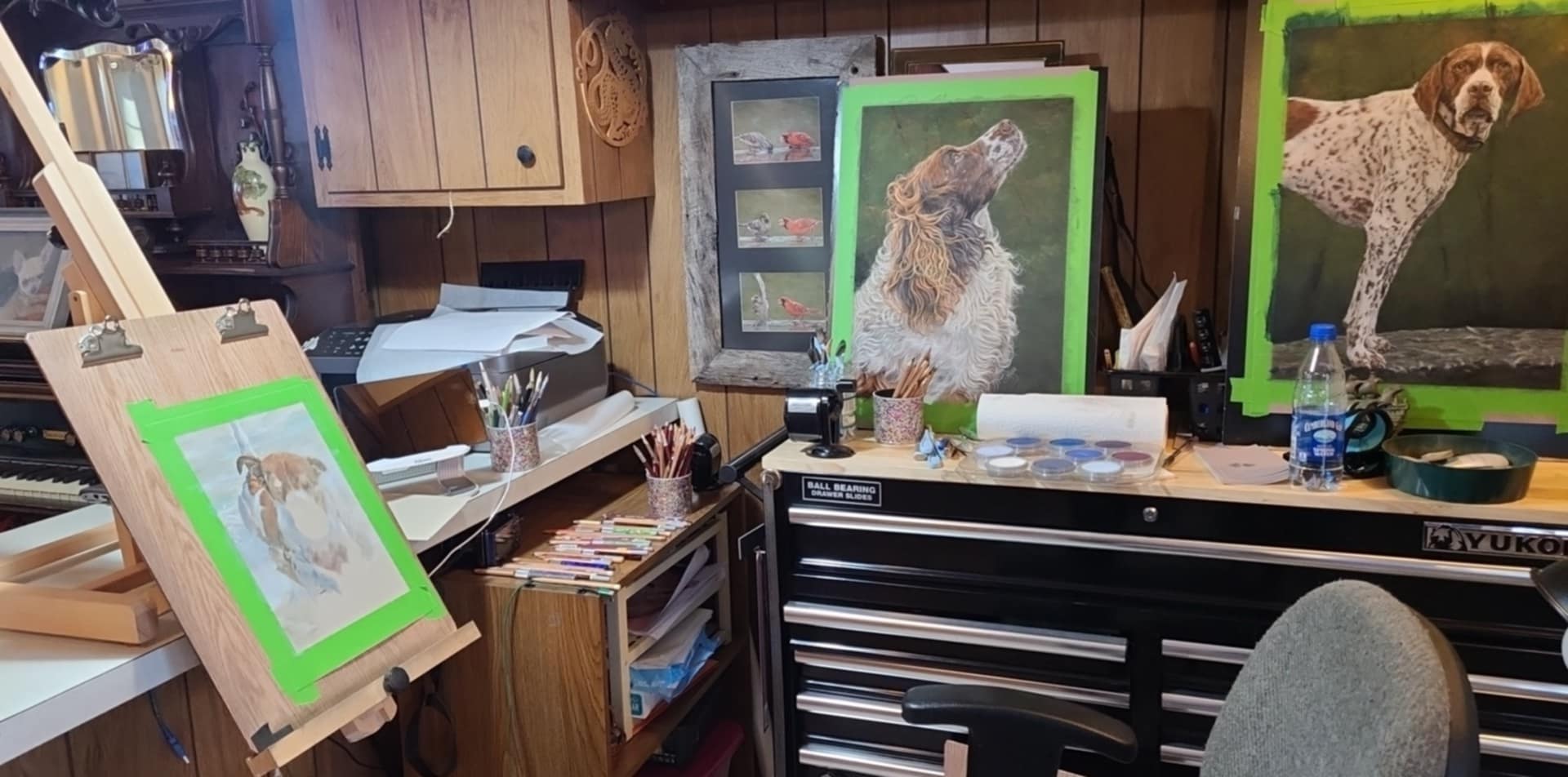
Aker's studio in the den of her basement
Kate: So pastel, is there something special about this? I think of crayons, but I think there must be different kinds of pastels, because some of your work almost looks like pencil work or crayons.
Lesa: There are basically three kinds of pastel. The sticks that everybody knows. There are the pen pastels that are more like compact makeup powder in all these different colors, and then there are pencils. The pencils do the details and the others do everything else.
Kate: And do you have some sort of way of keeping all these straight and tidy and in little drawers and boxes?
Lesa: Yeah. When I'm not working too hard, they look pretty neat. But when I'm doing something, they're not too neat.
Kate: Okay. That's a giveaway if you're busy. Lesa, your detailing in your work is incredible. I'm thinking maybe those are the pencil pastels you just mentioned. So the detail and the way you manage to translate your love of animals into your work is really awesome. I know you've lived all your life on a farm in Eubank near Somerset. Tell us a little bit about how you think farm life has influenced your work as well as your love of nature and animals, which is primarily what you paint.

Lesa: I don't really know the answer to that other than I have lived here all my life. I like it out in the country. I'd rather be with animals any day than humans. It's just what I like to do. We connect. I can connect with almost any animal I see. It's been amazing.
Kate: And how many animals do you have yourself?
Lesa: I have nine horses, two dogs, six cats, and a couple of possums that visit me every night. We used to have beef cattle.
Kate: No birds?
Lesa: Well, I feed birds too. Yeah, there's a lot of birds.
Kate: And your work that I've experienced is primarily animals, primarily dogs and horses.
Lesa: Yes.
Kate: I'm always struck by how realistic your work is and how you've managed to really infuse the work with your feelings for these animals. So much so that the first time I saw your work, I rudely told you that I really liked your photograph. So how do you react to people who, like me, assume that your work is a photograph because it is so realistic?
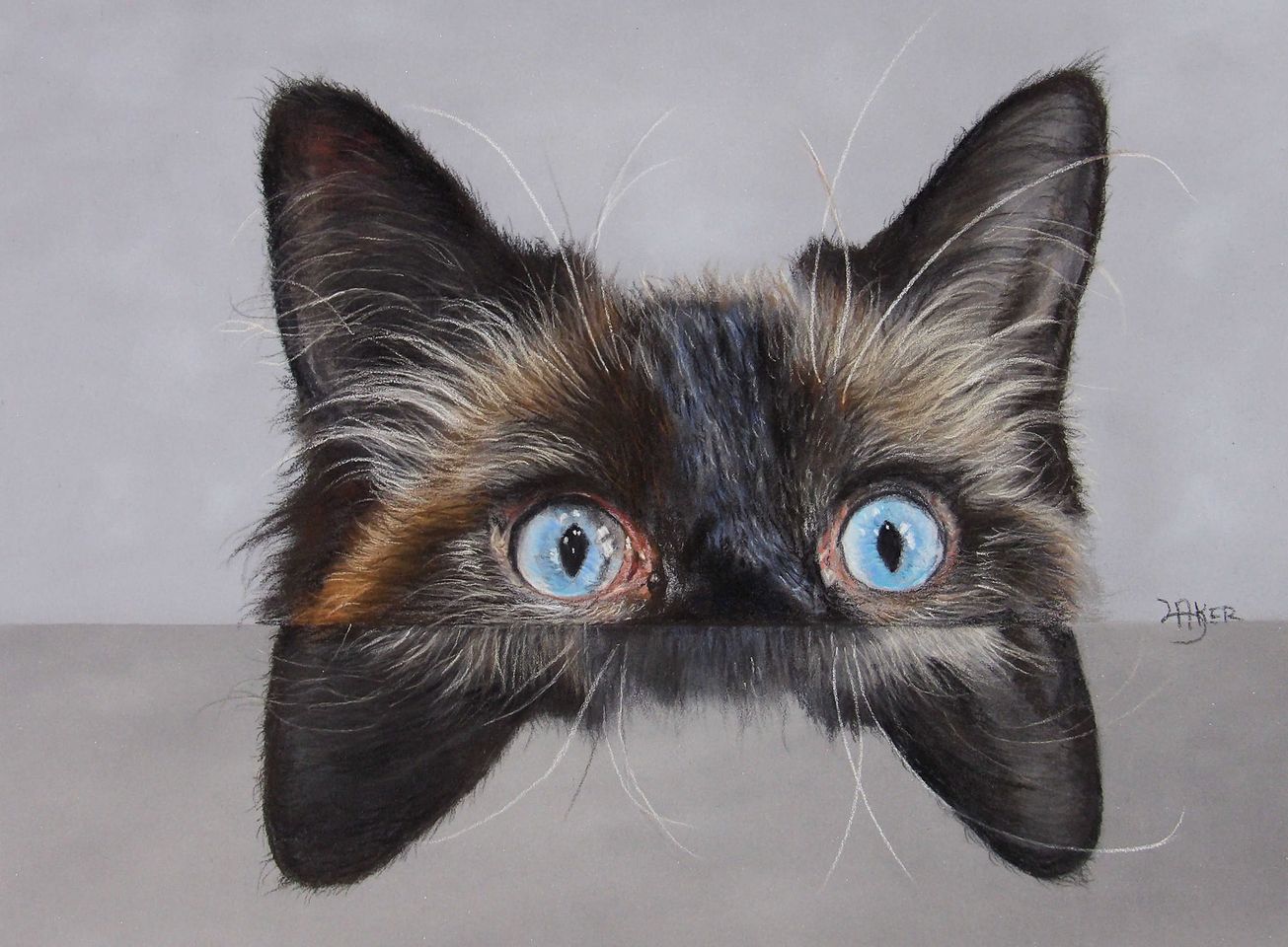
Peek-A-Boo
Lesa: I just say thank you because that's quite a compliment. A lot of people don't like realism. They say it's not artsy. But I say it is. It just depends on what you like. I'm detail-oriented with everything. That's all I know how to do and that's what I enjoy doing.
Kate: Well, impressionism and abstract art is not something you think you might sort of try out or wander into at some point?
Lesa: No. I wouldn't know where to start with abstract. Impressionism, I do love other people's work. But for now, I'm going to stick with this. This is what I love.
Kate: Yeah, well, and if you're good at it, why not? Why not stick with it? The piece that's out at the Headley Whitney Museum is just charming. It's a French Spaniel, I think?
Lesa: Yes.
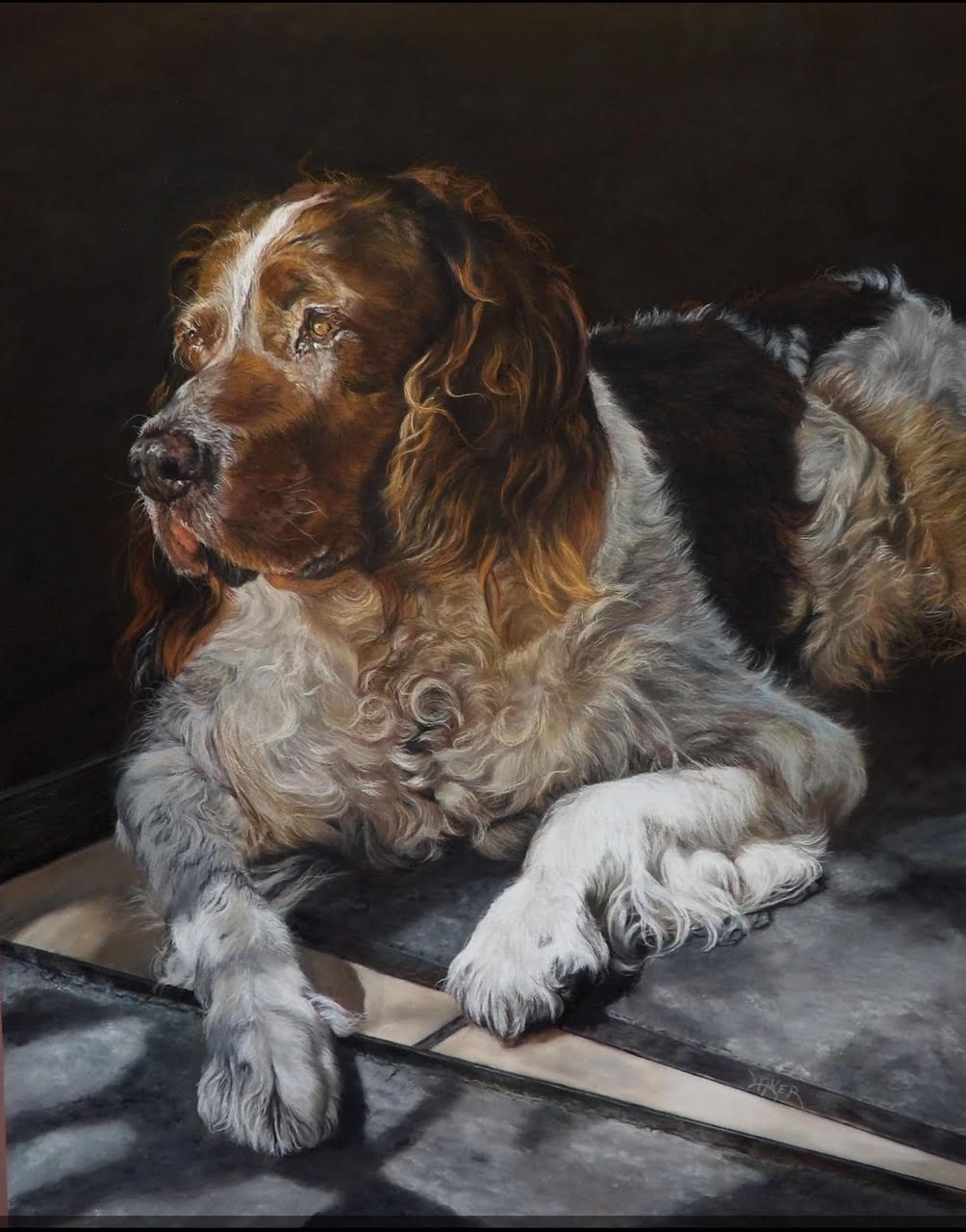
Gus
Lesa: Yes. Usually from someone else's. I'm not the best photographer in the world. They generally get changed quite a bit as far as the backgrounds and the lighting. But yeah, it's mostly all from photographs.
Kate: Well, I've enjoyed talking to you. I love your work. And thank you so much for being my guest today, Lesa.
Lesa: Thank you, Kate. Appreciate it.
Lesa Aker's works can be viewed and purchased online from the Arts Connect store.